Showing posts with label World cup history. Show all posts

Sunday, July 05, 2026

Brazil-Norway preview

I think that today's match between Brazil and Norway has the potential of being a great match. Norway has been playing some excellent football led in particular by the two stars Martin Ødegaard and Erling Haaland, while Brazil has shown the potential to get far, even as their name is not among the biggest favourites, with Vinicius Jr. as the main star so far. Norway's attacking prowess is without question, but their defense has more than once proven shaky during the tournament, something that Ancelotti has probably eyed. Raphinha still appears to be doubtful, but may be replaced by Neymar, something that could prove either a huge risk, or a huge opportunity. 

It is notable that Norway is one of the few countries in the world that has never lost to Brazil. They have only played four times, with two victories for Norway and two draws. In 1998 they faced one another in the group stages of the World Cup that France later won against Brazil in the final. Norway won 2-1 with two heroic goals within the last ten minutes of the match by Tor-Andre Flo and Kjetil Rekdal, after Bebeto had brought Brazil ahead. Brazil still won the group, but the victory meant that Norway advanced to the round-of-16, where they were eliminated by Italy.

So no matter what happens it will be history!

Another thing: after a disgraceful match with a team that refused to play football like Paraguay, I hope to see two teams of real sportsmen for whom fighting does not mean to be violent pricks (like Paraguay), but who will compete hard, as equals and with mutual respect. 

Good luck to both and may the best team win!

Tuesday, June 23, 2026

The Legend Leo Messi

Lionel Messi scored his first World Cup goal at the 2006 World Cup, at the age of 18, in a 6-0 against Serbia-Montenegro. It was the only goal he scored in that tournament, but today, 20 years and one week later, Messi has made history by scoring both goals in Argentina’s 2-0 victory over Austria. 

With 18 goals, he is now the most scoring player in World Cup history, two goals ahead of Miroslav Klose and Ronaldo Nazarinho. And we will probably see more goals from the Argentinean magician/legend, as Argentina is looking to win the group with one match to go against Jordan. 

We all witnessed history today.

Wednesday, June 17, 2026

The World Champions have checked in

Defending world champions often struggle to defend their title, but for Argentina tonight this was not the case. A solid 3-0 victory over Algeria, but most notably with an incredible Lionel Messi, who at his tender 38 years appeared to be everywhere on the pitch, and scored all three Argentine goals, equaling Miroslav Klose as the most scoring player in a World Cup.

Argentina also appeared solid in defense although I find it hard to assess how good the Algerians were. They passed the ball well and at times managed to put pressure on Argentina, but never really appeared to threaten the South American goal. At the same time they played slowly, something that only appeared to make the Argentineans comfortable. But it all may be to the credit of solid defense by Argentina.

While Spain grossly disappointed with 0-0 against Cape Verde, France won 3-1 over Senegal on a great second half and two Mbappé goals. Three of the biggest favourites for the title have started at different levels, but one thing is sure; everyone will be watching for Messi to break yet another historic record in his 6th World Cup.

Sunday, June 07, 2026

Chasing my World Cup dream

 I just read an interesting note by Irish journalist and author Paul Howard: "You spend your life chasing the way the World Cup made you feel when you were 11". The title says it all, and as this next world cup is slowly creeping up I can completely identify.

I have some vague memories of 1982, when I was 7 years old and living in Argentina: supporting Italy in the final, Hungary winning 10-1 against a country named "El Salvador" (first time I heard about it, and later in fact becoming very important in my life), and most of all, Argentina and the unfulfilled expectations of Maradona.

But in 1986 I was 11 years old. With my parents we were coming from Argentina, and spent some months in Mexico just before the World Cup. I was gripped by the fever, also because it was Denmark's first World Cup. I watched most of the World Cup in Denmark, who played some of the best football Denmark has ever played in matches against Uruguay and West Germany, as well as the debacle against Spain, that was indeed very difficult for an 11-year old Denmark supporter. But I also remember so many magic matches: USSRs extraordinary thrashing of Hungary; Mexico's wave and Jorge Negrete's special goal against Bulgaria; Belgium's great but lucky side against USSR; France-Brazil, which to me at that time was the best match I had ever seen; and most of all I remember Argentina and Diego Maradona, bringing the trophy home to a country that I had recently left physically but not by heart.

It was magic indeed, and I have since been searching for that feeling. I have enjoyed and vividly remember every World Cup since: 1990 living in Spain but still bitter at Spain's victory against Denmark, and wholeheartedly supporting a boring Argentina; 1994, opening match Germany-Bolivia, on the very day that I got my "studenterhue" and being in Colombia when Pablo Escobar was shot; 1998, painting a kitchen with my best friends and enjoying every crazy match (1998 is the closest I have come to feeling like in 1986); 2002 while finishing my Masters' and early breakfast matches that have since been difficult to remember from the least memorable World Cup; 2006 in Ghana, loving the atmosphere of the Black Stars' first world cup and disappointed about the final; 2010, recently living in Venezuela and thinking back of my time in Africa (Ghana and Mozambique) and watching the final (and finally able to celebrate my dear Spain) with my best friends in France; 2014, when I really went hunting for the "feeling", and traveled to many countries to watch matches, starting in Liberia, and ending in Denmark, and accepting the nevertheless disappointing loss of Argentina, against a German side that I admired for the first time ever; 2018, when I went to Russia with the best friend and enjoyed the atmosphere that the tournament brings, but also saw more clearly FIFA's obvious destruction of the game; 2022, the winter World Cup where I remember my enormous happiness seeing Argentina finally win again with best friends after a Julefrokost.

A four-year diary of my life, but while I have enjoyed, nothing comes close to the footballing magic of 1986.

It is serendipitous that now, 40-years later, I am living in Mexico for the biggest World Cup in history... But I am also older, worn-out, and more cynical person than that happy and dreamy 11-year old in 1986... I have seen my favourite teams win and lose; ups and down in life, and will surely not be as emotional about winning or losing. 

Behind my cynicism about FIFA and the destruction of the game I learnt to love 40 years ago, I am perhaps hoping - maybe still searching for that football romantic in my soul, like the great Uruguayan writer Eduardo Galeano once said: "Yo no soy más que un mendigo de buen fútbol. Voy por el mundo, sombrero en mano, y en los estadios suplico una linda jugadita, por amor de Dios. Y cuando el buen fútbol ocurre, agradezco el milagro..." ("I am nothing more than a beggar for good football. I wander the world, hat in hand, and in stadiums I plead for a beautiful play, for God's sake. And when good football happens, I give thanks for the miracle").

That is why, that despite it all, I am going to two matches here in Mexico. Behind all of my anger about the greed and ugly nationalism that I feel the World Cup has become, I am still pleading for the magic of a beautiful play and to feel some of the passion and beauty that made me fall in love with football and life as an 11-year old in 1986.... 

Wednesday, February 25, 2026

Greatest World Cup Matches: Spain-Japan (2022)

Spain entered the 2022 World Cup as one of the favourites. Following their 2010 title Spain had been an eternal favorite with hugely talented sides based on the apparently neverending flow of talented players. 

Spain had qualified ahead of Sweden and Greece, only losing one match, but manager Luis Enrique was nevertheless criticised for the style and selection of players, in particular the veteran Atletico Madrid player Alvaro Morata. 

That said, the 2022 squad combined experience and youth: The captain was FC Barcelona’s Sergio Busquets, only player left from the legendary 2010 side. The goalkeeping post had been taken over by Bilbao’s Unai Simon, while the experienced Cesar Azpilicueta from Chelsea led a defense that included Manchester City’s Aymeric Laporte, Villarreal’s Pau Torres, the Real Madrid veteran Dani Carvajal, as well as Barcelona players that included veteran Jordi Alba, and the youths Eric Garcia and Alejandro Balde. Midfielders included Macnhester City’s Rodri, Ateltico Madrid’s Koke and Marcos Llorente, as well as Barcelona youths Gavi and Pedri, both players who had already accumulated good experience despite their young age. There were few all-out strikers, but many players with strong offensive capabilities, that besides the criticised Morata also included Real Madrid’s Marco Asensio, Athletic Bilbao’s talented Nico Williams, RB Leipzig’s Dani Olmo, and Barcelona’s youths Ferran Torres and Ansu Fati. 

Seeded in the top layer for the World Cup draw, Spain ended in a difficult group that included Germany, Costa Rica and Japan. Spain opened against Costa Rica and completely dominated a match they won 7-0, immediately becoming a team to watch. In their second match they played Germany and tied 1-1, and were to face Japan in the last group match. 

Japan had made important advances in football since its co-hosting of the World Cup in 2002, but had never made it past the last-16 in a World Cup. Still, they were considered a side to look out for as more and more Japanese players were making their mark in their clubs, and the team had qualified by winning 15 of 18 matches. The veteran Eiji Kawashima from Strasbourg was goalkeeper, but was replaced by another experienced goalkeeper Shuishi Gonda, from Shimizu S-Pulse. The experienced Maya Yosida from Schalke 04 was captain of the team and led from defense, alongside Ko Itakura from Borussia Monchengladbach and Wataru Endo and Hiroki Ito, both from Stuttgart. Takehiru Tomiyasu from Arsenal, and two players from Kawasaki Frontale, Miki Yamane and Shogo Tanigushi completed a strong group of defenders. A solid midfield included Wataru Endo, also from VFB Stuttgart, Ritsu Doan from SC Freiburg, Kaoru Mitoma from Brighton & Hove Albion, Takuni Minamino from Monaco, Daichi Kamada from Eintracht Frankfurt, and Takefusa Kubo from Real Sociedad. Strikers included Takuma Asano from VFL Bochum, Daizen Maeda from Celtic and Ayase Ueda from Cercle Brugge. 

Perhaps they were underestimated by  big European sides, but that proved wrong as the Japanese, with many players from German clubs, defeated Germany 1-2 in their opening match, after coming back from 0-1 down. Japan were big favourites against Costa Rica, who nevertheless came back from their Spanish routing, and won 0-1. 

So before their last group match Japan needed a good result against Spain in order to qualify for the next round. 

Spain were favourites as manager Luis Enrique put on a strong side for the match, and already early on it showed as Spain had possession and pressure in the opening phase of the match. It only took 11 minutes before the oft-criticised Alvaro Morata put his head on a cross from Azpilicueta and brought Spain ahead 0-1. Spain continued to dominate a first half with few shots on goal, and with Spain leading in possession. 

With the score in the other match 1-0 for Germany, it meant that Japan were eliminated, and Manager Harime Morijasu made two offensive changes: Kaoru Mitoma came on for Yuto Nagatomo, and Rutsu Doan came on for Takefusa Kubo. The changes were similar to those Morijasu made against Germany, and exactly like in that match it was the Freiburg striker Ritsu Doan who soon scored with a wonderful left-footed strike from outside the box to the top right corner of the Spanish goal. 

The goal clearly shook the Spaniards, who seemed perplexed at the sudden Japanese dominance, and only three minutes Japan took the lead: A low cross into the Spanish area appeared to go past the goal-line as Kaoru Mitoma rushed to make a cross; he reached the ball and crossed it into Ao Tanake, who from close to the goal-line slotted the ball into goal. 

The Spaniards protested loudly that the ball had gone out of play, and it did appear so indeed on TV. But this is when the Video Assistant Referee (VAR) came in for a lengthy review and the goal was awarded with the argument that the ball was still touching the line, and thus still in play. 

VAR had been introduced at the 2018 World Cup, and this was surely one of the most marginal decisions: the ball appears to be out from a lot of angles, but from directly above, part of the curvature of the ball appears to still touch the line... 

With a 2-1 lead Japan naturally pulled back as Spain again took over the match; Spain had the ball almost all the time (they ended up with possession of 82% and 962 passes over Japan’s 188!), but was unable and without fantasy to force Japan’s disciplined and determined defense. 

In the other match Costa Rica surprisingly took the lead over Germany, a result that would mean that both Spain and Germany would be sensationally eliminated! Luis Enrique put in more strikers; chances only arrived towards the end of the match, but Japan held strong, and won the group. 

In the meantime, Germany managed to get back and win 4-2 over Costa Rica, meaning that Spain took second place in the group, while Germany and Costa Rica were out. The victory was historic for Japan, who topped a group for the first time since 2002 when they played at home. Nevertheless, they were eliminated in the last-16 after penalty kicks against Croatia, but surely will never forget this memorable (VAR) win over Spain.

Match Stats: 

  • Qatar, December 1st, 2022, Khalifa International Stadium 
  • Attendance: 44,851 
  • Referee: Victor Gomes (South Africa) 
Spain-Japan 1-2 
Goals: 1-0 Alvaro Morata (11) 1-1 Ritsu Doan (48) 1-2 Ao Tanaka (51)

Teams: 

Spain: Unai Simon; Rodri, Pau Torres, Cesar Azpilicueta (Dani Carvajal, 46), Alejandro Balde (Jordi Alba, 68); Gavi (Ansu Fati, 68), Sergi Busquets, Pedri; Dani Olmo, Nico Williams (Ferran Torres, 57), Dani Olmo, Alvaro Morata (Marco Asensio, 57). Manager: Luis Enrique 
Japan: Shuishi Gonda; Ko Itakura, Maya Yoshida, Shogo Tanigushi; Junya Ito, Ao Tanaka (Wataru Endo, 87), Hidemasa Morita, Yuto Nagatomo (Kaoru Mitoma, 46); Take Kubo (Rutsu Doan, 46), Daizen Maeda (Takuma Asano, 62), Daichi Kamada (Takehiro Tomiyasu, 69). Manager: Hajime Moriyasu 

Tuesday, November 25, 2025

The fury and the dream

In 1982, Northern Ireland arrived at their second ever World Cup. Despite the country’s rich footballing tradition, expectations were modest as the small British possession prepared to face Yugoslavia in their opening match. A hard-fought 0–0 draw offered a glimmer of hope: with a win over the unfancied Honduras, a place in the next round seemed possible. 

But a frustrating 1–1 left them on the brink. 

Their final match would be against the hosts — Spain. Back then, Spain were not celebrated for their style, but for La Furia — “The Fury.” 

Backed by passionate crowds and, at times, sympathetic refereeing, the home side were overwhelming favourites against the modest Irish team. Even Northern Ireland’s own players had little faith; they confirmed their plane tickets and checked out of their hotel before the match. 

But football thrives on disbelief. Against the odds, Northern Ireland stayed — not only in the tournament, but in history — when Gerry Armstrong, Watford’s tireless striker, scored the decisive goal in a 0–1 victory. Spain’s fury could not overcome Irish heart.

Sunday, October 26, 2025

Mexico Exhibition

Mexico is preparing for the World Cup. A World Cup that given its ticket prices is only to be witnessed by the wealthiest people... 

This World Cup is the third one to take place in Mexico, and a beautiful exhibition on Avenida Reforma, alongside the Chapultepec Park in Mexico City, shows this history through images by the outstanding artist Cynthia Saide. 

The 1970 World Cup in Mexico was historical in many ways, but notably on one technological improvement: it was the first World Cup to be transmitted to the World in colour TV. 

The images of Pele, The King,  celebrating his third World Cup title in the mighty Azteca stadium after thoroughly defeating Italy in the final, were seen in colour across the World, and surely led to more of globalizing football.

But it was not only Brazil, Pele and colour TV (as well as some fantastic matches and a marvelous atmosphere) that made the 1970 World Cup special. The tournament also saw the introduction of one of the rules that we take for granted today: the use of yellow and red cards.

After the violence and questionable decisions of many matches in the 1966 World Cup, the introduction of this system was to try to curve the violence and give the players a warning before being sent off.

The first red card was awarded by the Turkish referee Dogan Babacan to the Chilean player Carlos Caszely in the first round match between Chile and West Germany.

And thus a rule was born on Mexico.

The 1986 World Cup in Mexico was not supposed to have been. The tournament had been awarded to Colombia, but Mexico stepped in when Colombia was unable to go ahead with the organization.

Despite a horrible earthquake barely a year before the tournament, Mexico stepped in to organize what to many people who lived it has been one of the best World Cups ever (and totally subjectively I include myself, thanks to the performances of Argentina and Denmark); many fantastic matches and some of the best collection of players, overshadowed by the most extraordinary of them all: Diego Maradona, who in Mexico reached heights perhaps never seen in a World Cup. At the Azteca Stadium, against England in the quarterfinals, he scored two of the most memorable goals in history (for good and for bad), and was eventually crowned World Champion with Argentina beating West Germany in a very exciting final.

Legends were made in Mexico in 1986.

The exhibition by Ms. Saide includes many other fantastic pieces, and I would recommend anyone in Mexico City to see it.

That said, my last picture, here to the right, has a more personal character. It shows the clock counting down to the World Cup, and in the background you can see a large building, which is a large hotel in Mexico City. In 1986 I was in Mexico as an 11 year old kid before the World Cup, and enjoyed the same type of warm-up to the tournament as I am seeing now, 40 years later, when I am again living in Mexico, and looking forward to what will hopefully be another historic tournament, notwithstanding the fact that it has 48 teams, takes place in three countries, and that ticket prices are completely overblown.

But ok, such is the world of today. 

Saturday, August 30, 2025

Angels with Dirty Faces

I just finished the book "Angels with Dirty Faces", by Jonathan Wilson. It is the footballing history of Argentina, and it is told vividly and in fascinating detail, from the early days of football in Argentina, brought over by the British, and in particular Alexander Watson Hutton, a Scottish teacher who was the spearhead in setting up the Argentinean league and founding the Football Association in 1893. It is indeed fascinating how the love-hate relationship of Argentina with England appears as a recurring theme, from the early adoption of the game to the legendary 1986 World Cup quarterfinal when Maradona scored his two most memorable goals, which are very much put in context in the book; the boy from the poor South American background who could do magic with the ball: "...a pibe with a dirty face, a mane of hair rebelling against the comb; with intelligent, roving, trickster and persuasive eyes and sparkling gaze that seem to hint at a picaresque laugh that does not quite manage to form on his mouth, full of small teeth that might be worn down through eating yesterday's bread. His trousers are few roughly sewn patches; his vest with Argentinian stripes, with a very low neck and with vmany holes eaten out by the invisible mice of use. A strip of material tied to his waist and crossing over his chest like a sash serves as braces. His knees covered with scabs of wounds disinfected by fate; barefoot or with shoes whose holes in the toes suggest they have been made through too much shooting. His stance must be characteristic; it must seem as if dribbling with a rag ball. That is important: the ball cannot be any other. A rag ball is preferable bound by an old sock. If this monument is raised one day, there will be many of us who will take off our hat to it, as we do in church".

This was written by a journalist in 1928 describing the ideal of a "criollo" footballer, made not by the British, but in the Argentinean "potreros", born in the street with cunning and magic. The book dwells a lot into Maradona, but does not fail to mention many of the legendary players that preceded him, from Guillerom Stabile, Luis Monti, Roberto Cerro, Bernabe Ferreyra, Antonio Sastre, Omar Corbatta, Jose Sanfilippo, and many others. 

The book puts all the history of Argentinean football in the context of the Argentine society, from its early days as a magnet for European migrants and growing rich amid the problems in EUrope, and also the time when Argentine football started to grow its own identity, not only in relation to the British, but also in relation to its little neighbour, Uruguay, who was the first seeing international success, and winning the first World Cup against an Argentina side who had many clashes against the arch-rivals, a rivalry that was later replaced by Brazil, something that also gets some great stories in the book.

In the 1940s Argentine football, and particularly club football, was perhaps the best in the World, but the national team did not perform, and strangely the political winds under Peron did not allow Argentina to play the 1954 World Cup. And in the 1958 World Cup when Argentina was humiliated 6-1 by Czechoslovakia, a wave of so-called "anti-football" went through Argentina, the first hints of the footballing schizophrenia of "Mennotism" versus "Bilardism" (style versus result) that becomes a theme in the book from the 1960s, and Estudiantes de la Plata victorious but largely hated team, for its football. In parallel with this, Argentina is going from crisis to crisis, economically, socially and politically.

The 1978 World Cup of course gets special mention, as it was held under a violent military dictatorship that wanted to win the cup at home, despite a Menotti who was largely seen as against the dictatorship. And even the reflection of how many political prisoners celebrated the victory against the Netherlands; as it was more than about a political victory for the regime, but more a victory for all Argentines in a country of paradoxes.

The book ends in 2016, shortly after the defeat in the 2014 World Cup final and the 2015 Copa America, when hopes were being put into a young Lionel Messi, who many still criticised for not being from the "potreros", and perhaps didn't fit in the Argentinean ideal of their players (and never having played in Argentina). The book is therefore not as optimistic when it ends; but it would be interesting to hear about the changes that led to the 2022 World Cup with Messi as its architect, and the enormous political changes that led to the election of Milei in 2023. A more cosmopolitan Argentina relying on players playing in Europe? Because while more and more Argentinean players were going abroad the quality of Argentinean clubs was decaying, with hooliganism rampant, something that sadly seems to be more the case today.

So even though the book ends some ten years ago, it is perhaps one of the best books to learn about the fascinating  history of Argentinean football, and in the context of the complex schizophrenia of Argentinean society. So I highly recommend it.


Tuesday, December 24, 2024

The Right to Play

Women have historically not had it easy in the male-dominated world of football, and only in the 1970s did most countries lift bans on women's football. I just listened to a very interesting podcast from Danish Radio, "Retten til Fodbold" ("The Right to Football") that through two Danish stories told about the challenges and discrimination faced by women in football.

The first story is an interview with Lone Hansen, a Danish player on the 1970 Danish National team that won the first women's World Cup in 1970, and facing the discrimination from the Danish Football Association (DBU) decided to become one of the first professional female players in Italy, in 1971, when she went to play for Fiorentina, where she stayed for four years, but never received any recognition in Denmark, where DBU only allowed women football after pressure from UEFA in 1972 (and even despite the fact that Denmark had won the Unofficial Women's World Cup in 1971).

The second story is more recent, and is that of the Afghan-born Danish player Nadia Nadim. Born in Afghanistan she experienced the Taliban takeover and her family had to flee to Denmark, where she was able to play football, and was spotted early on by scouts and was invited for the Danish National team despite all the discrimination she faced as a woman, but also as a refugee. Nadia Nadim went on to become a superstar and has been capped 104 times for Denmark!

Even today women face discrimination in football despite huge advances, and it is clear that this even happens in Denmark, and the amazing story of these two strong women is a welcome reminder, besides it being amazing stories.

Friday, December 30, 2022

RIP Pelé

Edson Arantes do Nascimiento, better known as Pelé, has sadly passed away at the age of 82. 

People continue to discuss who is the GOAT (Greatest Player of All Time), in particularly now, as Messi has taken his coveted World Cup title. 

It is a non-sensical and subjective discussion. Football is a team sport; any player depends on his or her team, and the number of titles or goals do not define a great player. 

There is simply no GOAT.

This said, Pelé was someone who defined the game; the first truly global superstar, a player who defined football, and who was a pioneer in terms of many of the brilliant details that we so often take for granted. Coming from deep poverty he was one of the most gifted players of all time, and came on with storm at the World Cup in 1958, when at 17 years he was the youngest player to score a World Cup goal against Wales in the quarterfinals. Then he went on to score three goals in the final against Sweden, remaining the youngest goalscorer in a World Cup final.

The 1958 title was Brazil's first World Cup title, and they went on to win again in 1962 and the legendary 1970 final, where Pelé captained and was the architect behind the spectacular 4-1 victory over Italy

Pelé is the only player ever to have won three World Cup titles.

Brazil has declared three days of official mourning for the passing of the Great Pelé, The King, showing what he meant to the country, but he was not only a Brazilian icon, but a global icon.

When Maradona passed, Pelé tweeted that "Um dia, eu espero que possamos jogar bola juntos no céu." (one day I hope we can play football together in Heaven).

That day has come, and they are playing some outstanding football today!

RIP Pelé.

Sunday, December 25, 2022

The Great Di Maria

As the hangover of Argentina's World Cup triumph fades there is a lot of focus on some of the great players who will retire after this World Cup. Most of the focus is obviously on Lionel Messi, who alongside Cristiano Ronaldo has dominated world football for 15-20 years (in 2006 I watched him play for Barcelona alongside Ronaldinho), and who has crowned his career with the World Cup title. But obviously a lot of attention has gone to Cristiano Ronaldo, Neymar, Luka Modric and Luis Suarez - players who have defined the last decade of football, delighted all real football fans, and are set to retire.

But I feel one player is being forgotten: Angel Di Maria has been one of the greatest players in the world for the last 10 years. He has had too many injuries in his career (including the 2014 World Cup final when Argentina could have plausibly won with him on the team against the forward defending slow German defense) and ups and downs in some of his clubs. But he has nevertheless been a defining player in all his clubs, but most notably in the national team, where, despite the fact that he has been overshadowed by Messi, he has stood out: he scored the winner when they won the 2021 Copa America, also scored the winner when Argentina won Olympic gold in 2008, and finally scored Argentina´s opening goal in the World Cup final, following a fantastic first half during which he was one of Argentina's defining players.

A modest player who comes from a very poor background, Di Maria stands out as both a player and a colleague, and if anything, I feel he does not get enough credit for a list of titles that he has certainly had a foot or two in getting for Argentina.

Angel Di Maria will be one of those players who will be missed in the future.

Wednesday, December 14, 2022

Argentina-France in the final

France defeated Morocco 2-0 in today's semifinal on goals by Theo Hernandez and Kolo Muani. Despite this France did not look as strong as expected, and Morocco should be proud of a match where they managed to put pressure on the world champions, who at times looked shaky.

Argentina surely looked on with interest.

Both sides can win: They are both teams with great players and deserve to be in the final. I do not hide my subjectivity in supporting Argentina, but beyond this also hope that the World Cup will end outside Europe for the first time since 2002

France and Argentina do not share a strong World Cup history. They have met three times:

Both teams have won the World Cup twice (Argentina 1978 and 1986, France 1998 and 2018). For Argentina though, this will be their sixth final, while France is playing their third.

The match will also be sold as a contest between two great players and teammates in Paris St. Germain: Lionel Messi and Kylian Mbappe have each scored five goals in the tournament and will be looking to become the most scoring player of the tournament.

Whichever way you turn it, it will be a match to go into history of the World Cups in the World Cup that should never have taken place.

Tuesday, December 13, 2022

World Champions in other things

 Croatia are World Champions in winning penalty contests, but that did not help them today against Argentina, who got a thorough revenge for the 2018 loss to Croatia.

It was most certainly the best we have seen Argentina play in the tournament, and although the Croatian team had its moments dominating possession, they never really looked to threaten the Argentines who were concentrated, organised and fought with a spirit that perhaps is better only by Morocco in this World Cup.

And although they were all good, two Argentine players stood out: firstly, the young Julian Alvarez, who joined Manchester City in September, scored two goals and forced the penalty that Messi scored on. And secondly the veteran Lionel Messi, who not only scored on a penalty, but also made a perfect run around Josko Gvardiol to set up Alvarez for the third goal. It was the kind of Messi one saw when he was young, but he is also showing the qualities of a leader that Argentina needs and wants.

Argentina are World Champions in World Cup semifinals: this was their sixth (1930, 1978, 1986, 1990, 2014 and 2022), and they have won every single time, but still only two title to show for it. The way they played today, Argentina can beat anyone in the final. But they still display some weaknesses and nerves (the pressure is enormous on these players), meaning that they can also lose to anyone.

I hope to see them win their third title.

No matter what happens in the final, Argentina are World Champions football fans: the passion the fans have put into the matches is unique, and surely it will carry the team to try harder and harder.

Thursday, December 08, 2022

Argetina versus Netherlands in World Cups

Tomorrow Argentina will face the Netherlands in what will be one of the most awaited quarterfinals of the tournament. Two great teams each in their way: the Argentina of Lionel Messi remain candidates for the title, but as yet to be really convincing, while everyone knows that the Dutch have the quality to make it all the way but appear to be unrealiable, and they are certainly not invincible as shown by Ecuador.

Historically it is also a special match. The two countries have faced one another four times before in a World Cup:

So in terms of World Cup history the Dutch have a slight edge over Argentina, although Argentina seems a bit better when it counts. 

Of course history counts for nothing when they face one another this time! Two fantastic teams, great fans (yes, I fully admit to have joined their ranks once in a while!), and what promises to be another historical match between them.

Go Argentina!

Saturday, December 03, 2022

The World's 16 best footballing nations

The Qatar World Cup continues to be an ugly political event that has come to symbolize ugly nationalism, disrespect, inequality, abuse and greed.

But I think this is just a symptom of our world.

In footballing terms the group stages have been interesting. After Brazil sensationally lost to Cameroun (and frankly this is as surprising as Argentina losing to Saudi Arabia or France losing to Tunisia) it is the first tournament since 1994 during which no team has gone through with maximum points (the same happened in 1958 and 1962, so it is not a common occurrence). But more interesting is that this is the first World Cup where all continental federations (except Oceania) are represented with at least one team (CONCACAF 1, CONMEBOL 2, CAF 2, UEFA, 8, AFC 3). 

The eight matches are as follows:

  • Netherlands-USA: The Dutch got through with two victories and one difficult tie to Ecuador, and are surely not as strong as they should be. USA is the only representative from CONCACAF and looked well-organised to defeat Iran and tie England. It will surely be difficult for the Dutch, but I hope they prevail
  • Argentina-Australia: Despite their opening loss to Saudia Arabia Argentina won the group and remain favourites. They are surely huge favourites against Australia. The Asian representatives went through on hard work but winning against two poor sides, Denmark and Tunisia. They were overrun by France and should be on their best to defeat Argentina (but certainly not impossible). I support Argentina wholeheartedly.
  • France-Poland: The defending champions are looking strong, but lost to Tunisia in a match with many substitutes. They are surely favourites against the Poles, who look delighted just to have gone through. That said, no expectations could be Poland's strength as they still have quality players who could hurt France. But I expect France to prevail.
  • England-Senegal: England will underestimate Senegal, that is a given, and I will surely support Senegal, where other players have stepped up in the absence of Sadio Mané. Koulibaly was spectacular against Ecuador and will face English players he knows well. It will be a close match I think, with England as weak favourites.
  • Japan-Croatia: Japan winning the Group of Death is one of the surprises, and Croatia have surely seen that Japan defeated both Germany and Spain, although also that the Japanese do have weaknesses. If Croatia can take advantage of their quick passing then they could hope for a repeat of 2018. Japan I think are slight favourites though.
  • Brazil-South Corea: The Corean victory against Portugal means that they prevented us from a repeat of the "Maracanazo" classic between Brazil and Uruguay. Don't mind that though. Corea and in particular their fans are the best side through. Brazil are enormous favourites, but the Coreans do and should not fear anybody, and could cause a sensation!
  • Morocco-Spain: This is probably the clash I look most forward to. Neighbouring countries; the African upstart with a great team and confidence, against the European giants with some truly fantastic players. It has all the ingredients to be a fantastic match!
  • Portugal-Switzerland: The Portuguese went through on first place with two wins and one loss, but appear not to have been tested yet. Switzerland will surely be a test. They showed their quality already in last year's Euro when eliminating France in an extraordinary match, and in this tournament have shown themselves solid in the back, but also strong in attack when it counted against Serbia. This match could go to either side!

Friday, December 02, 2022

Morocco repeating history

In 1986 Morocco were the first African team that were group winners in a World Cup. They won the group ahead of three European nations (England, Poland and Portugal). Although Morocco were eliminated by a rather disgusting and foul West German side in the last-16, they were pioneers of the era when African teams were to be reckoned with (Cameroun and Algeria had already warned about this in 1982). 

That is why it is so great that Morocco has again won a World Cup group, and again ahead of two European powerhouses, Croatia and Belgium; the latter ranked number 2 in the world, and surely never expected to be out to Morocco! 

All Morocco needed in their last match was to defeat the already-eliminated Canadians to win the group, and 25 minutes into the match were already ahead 2-0 on goals by the great Hakim Ziyech and Sevilla's Youssef En-Nesyri. Although they did suffer after an own-goal by  Nayef Aguerd, the score held (with a bit of luck), and as Croatia tied the hapless Belgians (surely the end of the golden generation), Morocco were group winners and a delight for Africa and the world!

Morocco will face Spain in what will be a clash to look forward to. Not only neighboring countries with close relations, but also many Moroccan players who play in Spain and know Spain well, such as PSG's Achraf Hakimi (born in Madrid and came through Real Madrid's youth academy), Sevilla's goalkeeper Yassine Bounou, or Osasuna's Abde Ezzalzouli (who has come through Barcelona's youth). 

Spain are surely favourites, but Morocco has shown that they are a strong and competitive side that does well against European sides that underestimate them. Spain would be wrong to underestimate a team that seems to be riding on a wave!

Tuesday, October 25, 2022

Greatest World Cup Matches: France-Croatia (2018)

Russia had been a controversial choice to host the World Cup, but had prepared well for a tournament that covered large distances, but also showed Russia from its best side, despite all the initial misgivings.

France had entered the tournament as one of the pre-tournament favourites, just as they had done two years before at the 2016 Euros, where the team had nevertheless been defeated by Portugal in a very boring final. Manager Didier Deschamps, who had captained France to their 1988 World Cup title most definetly counted with one of the most talented sides in the world: a solid midfield with some of the world’s best midfielders in Manchester United’s Paiul Pogba and the Chelsea’s ever-working genius Ngolo Kanté, as well as Juventus’ experienced Blaise Matuidi. Also defensively the teams stood strong with Tottenham’s Hugo Lloris on goal, behind Real Madrid’s Raphael Varane and Barcelona’s Samuel Umtiti, and two excellent backs in Stuttgart’s Benjamin Pavard and Atletico Madrid’s Lucas Hernandez. But what was strongest was its attacking prowess, led by the young genious of Paris St. Germain’s Kylian Mbappé, alongside Ateltico Madrid’s Antoine Griezmann and Barcelona’s Ousmane Dembelé. France’s manager, Didier Deschamps, had even cut out the star striker from Real Madrid, Karim Benzema, amid some controversial rows among players.

France had won a difficult qualification group ahead of Sweden, Netherlands and Bulgaria, but were not impressive in the first round of the tournament: they defeated Australia 1-2, Peru 0-1, to tie Denmark 0-0 in a bore of a match to win the group. In the last-16 France faced a potentially strong Argentina with a shambolic defense in what turned out to be a great match, France won 4-3 with some fantastic goals, and France coming back from being 1-2 down. In the end it was in Kyllian Mbappé’s speed that made the difference, him winning the penalty kick of the first goal, and scoring two other goals to put France in the quarterfinals.

Uruguay were defeated 2-0 on goals by Varane and Griezmann for them to face the best team of the tournament in the semifinals: Belgium. In a strong match with many chances but two great goalkeepers, France won 1-0 on a header by the Barcelona defender Samuel Umtiti, and were ready for their first World Cup final since their 2006 defeat to Italy, where they were to face a surprising Croatian side.

Croatia had been at the top of World football since their independence, and had already made it far in the 1998 World Cup, when they reached the semifinals. They were always a team to be reconned with, having a long list of players in Europe’s biggest clubs, and the 2018 squad was no exception: an experienced defense that included Atletico Madrid’s SimeVrsaljko, Sampdoria’s Ivan Strinic and Liverpool’s Dejan Lovren, in front of Monaco’s Danijel Subasic in goal. Inter Milan’s Ivan Perisic and Juventus Mario Mandzukic were strong strikers, but the big stars were in midfield, where two of the world’s best midfielders dominated: Real Madrid’s Luka Modric and Barcelona’s Ivan Rakitic.

Despite this amazing lineup Croatia had not qualified directly: they had come second to the surprising Iceland (who in 2018 qualified for their first World Cup ever), but had qualified to Russia through a play-off victory over Greece.

Croatia were paired again with Iceland in the first round group, alongside Argentina and Nigeria, and the Croatians cruised through a group that looked difficult: they defeated Nigeria 2-0 in the first match, and completely outplayed Argentina, winning 3-0, in a match where Modric and Rakitic completely tore apart the South Americans. In the last match in Rostov, they defeated Iceland 2-1 and were alongside Uruguay and Belgium the only side to win all their matches in the first round.

In the last-16 Croatia faced Denmark in a very close match that ended 1-1 (with Modric missing a penalty in the dying minutes of extra time), and had to go to penalty kicks, where Croatia proved cooler, winning 3-2.

In the quarterfinals Croatia faced an exciting Russian home-team, who had unexpectedly made it to the quarterfinals after defeating Spain in the last-16. It proved an exciting match, with Denis Cherysev bringing the Russians ahead on a splendid goal, but Croatia equalising through Andrej Krmaric, and then going ahead 1-2 in extra time, before a fighting Russian side equalised in the dying seconds of the match. But as against Denmark, Croatia were the better side from the penalty spot, and were to face England in the semifinals.

There were, as always, huge expectations amid the English fans that they could make their first final since 1966, and probably also a bit of under-estimation of the Croatian side, whose penalty wins were also seen as lucky. And England did indeed start the best, and went ahead after only five minutes, but if anything, Croatia proved that they never give up, and after pressing in the second half equalised through Ivan Perisic, and in extra time Mario MAndzukic gave the Croatians the victory, and their first World Cup final ever.

Against all expectations and in their first World Cup final, Croatia started as the best team dominating possession and controlling the midfield. But as often happens, it was the French who went ahead in what was basically their first attampt: a free kick into the area was touched by Mario Mandzukic head, and the hero of the semifinal had brought France ahead with an own-goal. However, it did not shake the Croatians who deservedly equalized ten minutes later when Ivan Perisic controlled and powerfully shot from the edge of the area.

The 2018 World Cup had been the first to introduce Video Assistance Refereeing (VAR) to help referees in difficult decision. And VAR intervened for the first time in a World Cup final, although not without controversy. During a French corner kick the ball hit Ivan Perisic’s hand; initially the Argentine referee did not make a call, but watching the repeat on the VAR screen, he changed his mind and gave France a penalty kick that Antoine Griezmann scored.

In my opinion it was not a penalty.

2-1 at halftime, and although Croatia came out to play their chance in the second half, France appeared in control and ready to utilize the young Kylian Mbappé’s speed for their counter-attacks. France made it 3-1 by Paul Pogba, and it was indeed Kylian Mbappé who made it 4-1 with a powerful shot from the edge of the area. At only 19 years of age he became the youngest goalscorer in a World Cup final since the legendary Pelé in 1958. While Mbappé was not the revelation of the tournament, he was the tournament’s best young player, and had probably been awarded player of the tournament award had it not been for the brilliant Luka Modric.

With a 4-1 lead the match was effectively over, but France’s goalkeeper Hugo Lloris decided to give Mario Mandzukic a present but losing control of the ball in front of goal and letting Mandzikic push it into goal. Mandzukic is thus the only player to have scored for both teams in a World Cup final.

4-2 and France were champions for the second time since 1998, but Croatia had been a worthy and dignified finalist, and won many hearts. It was also the first final since 2002 that did not go into extra time, and was thus one of the most special finals in World Cup history, and a worthy final for a great tournament in Russia.

July 15th 2018  
Luzhniki Stadium, Moscow 
Attendance: 78,011 
Referee: Nestor Pitana (Argentina) 

Teams

France: Hugo Lloris (c); Raphael Varane, Samuel Umtiti, Benjamin Pavard, Lucas Hernandez; Paul Pogba, Ngolo Kanté (Steven Nzonzi, 55), Kylian Mbappe, Antoine Griezmann, Blaise Matuidi (Corentin Colisso, 73), Olivier Giroud (Nabil Fekir, 81). Manager: Didier Deschamps 

Croatia: Danijel Subasic; Slime Vrsalkjo, Dejan Lovren, Domagoj Vida, Ivan Strinic (Marko Pjaca, 81); Ivan Rakitic, Marcelo Brozovic, Ante Rebic (Ante Kramaric, 81), Luka Modric (c ); Ivan Perisic, Mario Mandzukic. Manager: Zlatko Dalic 

France-Croatia 4-2  

Goals

1-0 Mario Mandzukic (OG) (18) 
1-1 Ivan Perisic (27) 
2-1 Antoine Griezmann (p) (38) 
3-1 Paul Pogba (59) 
4-1 Kylian Mbappe (65) 
4-2 Mario Mandzukic (69)

Monday, September 26, 2022

Estadio Centenario

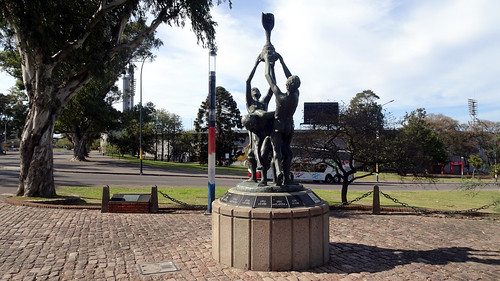
 I am visiting Uruguay, a legendary football nation. Unfortunately, due to recent crowd trouble, I was unable to go watch Peñarol, who were playing against Montevideo Torque without spectators (I watched a really boring match in a bar, with Peñarol losing 0-1 to one of the lowest placed teams in the league).

But I was able to visit the site of the legendary Estadio Centenario, site of the very first World Cup final of 1930. Unfortunately I found the museum to be closed on a Sunday, a big disappointment, but I was still able to walk around the stadium, see a statue honoring the Jules Rimet Trophy (including great homages to the Maracanazo in the 1950 World Cup final, which also defines Uruguayan football), and all in all take in the history of this beautiful country and city.

I hope soon to return to Montevideo, and see more of their football.

Scultpure to the Jules Rimet Trophy

Saturday, April 09, 2022

World Cup draw

 I have been busy with work, traveling, and non-football things in my head and heart, but I have nevertheless followed last week's World Cup draw, which points at some very interesting matches in Qatar (that should never have had the World Cup):

Group A:

  • Qatar
  • Ecuador
  • Senegal
  • Netherlands

This group could plausibly be the most difficult one to predict. Qatar are playing their first World Cup, but as hosts they have been preparing for years and will not want to disappoint at home (even though I will not support them). Senegal are African champions and with a strong core of experienced Europe-based players. Netherlands are always strong, but can also disappoint, while Ecuador has sufficient experience and skills to upset any team. Watch this group, and support all but Qatar.

Group B:

  • England
  • USA
  • Iran
  • Scotland/Ukraine/Wales

This is an interesting group that could potentially be the Anglo-Saxon world against Iran. Iran are surely not to be underestimated, having qualified with style, and will recall their 1998 group win over USA. England are probably favourites to win the group, but USA will recall that they have never been defeated by England in a World Cup, and most famously recall the 1950 miracle in Belo Horizonte. If Ukraine qualify, the group will be watched even more closely for political reasons in an already highly politicized World Cup.

Group C:

  • Argentina
  • Mexico
  • Poland
  • Saudi Arabia

This is a good draw for Argentina, although of course they should never underestimate any of the teams in the group. But Argentina is playing excellently, have a hungry Lionel Messi likely in his last World Cup, so should hopefully (I fully support Argentina) pull through. Mexico has looked very poor in qualification, so Poland and Saudi Arabia have good chances in pulling through, where expectations to Lewandowski's Poland will probably be highest.

Group D

  • France
  • Denmark
  • Tunisia
  • Peru/Australia

This group is curiously a 75% repeat of the 2018 group C, which included France, Denmark, Peru and Australia. That group was won by France (who went on to become World Champions), with Denmark as runners-up, and an excellent Peru was unlucky to be eliminated. France are surely favourites, but note that the defending winners tend to do badly when they have to defend their title (Denmark notably defeating France in 2002), and that may be a hope for the other teams. Denmark are surely much better than they were in 2018, but Peru will be looking to avenge their rather unfair 2018 defeat. Tunisia are the most unwritten chapter of the group, but never to be underestimated.

Group E:

  • Spain
  • Germany
  • Japan
  • Costa Rica/New Zealand

This could potentially be the "Group of Death". Two former World Champions Spain and Germany, and both teams are also contenders for the title. At the same time Japan is always highly competitive, growing stronger in every World Cup (remember their spectacular match against Belgium in 2018). In the meantime neither Costa Rica or New Zealand are to be underestimated: remember in 2014 when Costa Rica won the "Group of Death ahead of England, Italy and Uruguay?

Group F:

  • Belgium
  • Canada
  • Morocco
  • Croatia

This group has four exciting teams. Belgium is at the end of its most golden generation, and while they are still ranked number 1 in the world, one no longer has the feeling that they are able to go all the way. That said, they should be favourites in a group that sees the exciting Canadians, in the first World Cup since 1986, as well as Croatia, finalists and the world's darlings from 2018. Morocco is never to be underestimated, and may have hopes of fighting it out in the group.

Group G:

  • Brazil
  • Serbia
  • Switzerland
  • Cameroun

Brazil are surely huge favourites in the group, and contenders for the title that they have not taken since 2002. Of course they cannot underestimate any of the other teams, which have their strengths, but will have to fight it out between them. Switzerland may have a slight edge: a very strong team that eliminated France from the Euros, and won qualification ahead of European champions Italy, they have shown that they can take on everyone. Serbia has a strong base of experienced players but have never made it past the group stages since 1998. The same can be said of Cameroun; it is great to see the Lions in the World Cup again, but they have not made it past the group stages since 1990!

Group H:

  • Portugal
  • Ghana
  • Uruguay
  • South Corea

Portugal may be favourites in this group, even though nothing is written, of course, and Portugal can lose to all of these teams. That said, the match everyone thought about when they saw the draw was the legendary 2010 World Cup quarterfinal between Ghana and Uruguay, which saw Uruguay through after penalty kicks and Luis Suarez' infamous hand ball save. Ghana will look for revenge, but will have to keep their heads cool against an experienced Uruguay side, while Ghana at times has looked shaky (most recently in their disappointing Africa Cup of Nations). In the meantime South Corea is most certainly a team to reckon with, having qualified for every World Cup since 1986 they have the experience, although they have struggled to get past the group stages (That said, in 2018 they knocked out the defending champions of Germany).

Friday, August 20, 2021

Pelé

I recently watched a documentary on Netflix about Pelé, the legendary Brazilian footballer.

Pelé is perhaps the greatest player of all time, but certainly the greatest player of his generation. The documentary circles around his four World Cups and his importance at a time when Brazilian society was undergoing profound changes, with modernization and the wake of a dictatorship. The documentary dwells relatively much on the dictatorship, with an implicit criticism of Pelé never taking a clear stand against the dictatorship. Pelé at no time appears to be much interested in politics, and the issue remains relevant to this day: what can or should we expect from footballers, who have been thrown into an unlikely fame for the mere fact of kicking a ball. At the same time the documentary also shows how Pelé transcended football, becoming a world-wide super-star that symbolized and represented Brazil beyond all the political upheavals.

Pelé actually describes himself as an average guy that happened to be good at kicking a ball, and his enormous humility is extremely likeable, but it also borders on boring for a documentary about such a nice guy outside the pitch.

The footballing part is both the most relevant and interesting part of the tournament, and Pelé crying when he recalls the finals of 1958 and 1970 truly shows how much football and the finals meant for him. The interviews with many of his teammates such as Mario Zagallo, Jairzinho or Clodoaldo, also gives weight to Pelé as not only a great player, but also a great friend. At the same time I think that the very interesting stories behind the Brazilian team in each World Cup (including the 1966 World Cup, when opposing teams violently struck down on Pelé's brilliance) could have benefited greatly from including some of the opponents, in particular defenders and goalkeepers who had to struggle with a player of a quality that was almost unseen back then.

In the end the documentary is great for anyone interested in football history, and the focus of Pelé, who remains a legend among legends in international football, but the documentary could have been better.