Showing posts with label Mexico 1986. Show all posts

Sunday, June 07, 2026

Chasing my World Cup dream

 I just read an interesting note by Irish journalist and author Paul Howard: "You spend your life chasing the way the World Cup made you feel when you were 11". The title says it all, and as this next world cup is slowly creeping up I can completely identify.

I have some vague memories of 1982, when I was 7 years old and living in Argentina: supporting Italy in the final, Hungary winning 10-1 against a country named "El Salvador" (first time I heard about it, and later in fact becoming very important in my life), and most of all, Argentina and the unfulfilled expectations of Maradona.

But in 1986 I was 11 years old. With my parents we were coming from Argentina, and spent some months in Mexico just before the World Cup. I was gripped by the fever, also because it was Denmark's first World Cup. I watched most of the World Cup in Denmark, who played some of the best football Denmark has ever played in matches against Uruguay and West Germany, as well as the debacle against Spain, that was indeed very difficult for an 11-year old Denmark supporter. But I also remember so many magic matches: USSRs extraordinary thrashing of Hungary; Mexico's wave and Jorge Negrete's special goal against Bulgaria; Belgium's great but lucky side against USSR; France-Brazil, which to me at that time was the best match I had ever seen; and most of all I remember Argentina and Diego Maradona, bringing the trophy home to a country that I had recently left physically but not by heart.

It was magic indeed, and I have since been searching for that feeling. I have enjoyed and vividly remember every World Cup since: 1990 living in Spain but still bitter at Spain's victory against Denmark, and wholeheartedly supporting a boring Argentina; 1994, opening match Germany-Bolivia, on the very day that I got my "studenterhue" and being in Colombia when Pablo Escobar was shot; 1998, painting a kitchen with my best friends and enjoying every crazy match (1998 is the closest I have come to feeling like in 1986); 2002 while finishing my Masters' and early breakfast matches that have since been difficult to remember from the least memorable World Cup; 2006 in Ghana, loving the atmosphere of the Black Stars' first world cup and disappointed about the final; 2010, recently living in Venezuela and thinking back of my time in Africa (Ghana and Mozambique) and watching the final (and finally able to celebrate my dear Spain) with my best friends in France; 2014, when I really went hunting for the "feeling", and traveled to many countries to watch matches, starting in Liberia, and ending in Denmark, and accepting the nevertheless disappointing loss of Argentina, against a German side that I admired for the first time ever; 2018, when I went to Russia with the best friend and enjoyed the atmosphere that the tournament brings, but also saw more clearly FIFA's obvious destruction of the game; 2022, the winter World Cup where I remember my enormous happiness seeing Argentina finally win again with best friends after a Julefrokost.

A four-year diary of my life, but while I have enjoyed, nothing comes close to the footballing magic of 1986.

It is serendipitous that now, 40-years later, I am living in Mexico for the biggest World Cup in history... But I am also older, worn-out, and more cynical person than that happy and dreamy 11-year old in 1986... I have seen my favourite teams win and lose; ups and down in life, and will surely not be as emotional about winning or losing. 

Behind my cynicism about FIFA and the destruction of the game I learnt to love 40 years ago, I am perhaps hoping - maybe still searching for that football romantic in my soul, like the great Uruguayan writer Eduardo Galeano once said: "Yo no soy más que un mendigo de buen fútbol. Voy por el mundo, sombrero en mano, y en los estadios suplico una linda jugadita, por amor de Dios. Y cuando el buen fútbol ocurre, agradezco el milagro..." ("I am nothing more than a beggar for good football. I wander the world, hat in hand, and in stadiums I plead for a beautiful play, for God's sake. And when good football happens, I give thanks for the miracle").

That is why, that despite it all, I am going to two matches here in Mexico. Behind all of my anger about the greed and ugly nationalism that I feel the World Cup has become, I am still pleading for the magic of a beautiful play and to feel some of the passion and beauty that made me fall in love with football and life as an 11-year old in 1986.... 

Friday, February 20, 2026

RIP Sepp

 Sepp Piontek was a thoroughly likeable person. Behind the tough guy and the serious angry look there was always a hint of burlesque humour. He was the perfect boss: demanding and disciplined, but also a kind and friendly spirit. In that sense he was the perfect match for a Danish national team in the 1980s, full of arrogant young superstars who needed both a disciplined manager, as well as one open to their youth indiscretions.

In that regard Piontek turned a second-rate footballing nation into a footballing superpower in the 1980s, taking Denmark to the 1984 Euro semifinals and their first World Cup, in 1986 (incidentally here in Mexico), where the Danish Dynamite awed the world with a fantastic offensive style that Denmark has never managed to replicate. 

Despite the fact that Denmark won the 1992 Euros (under Piontek's assistant; Richard Møller Nielsen) and made it to the 1998 World Cup quarterfinals, I think that every Dane who witnessed the Danish Dynamite of the 1980s would agree that Piontek's team is the best football team that Denmark has ever had; they never won anything, but they made us dream, and that in the end is what football is all about!

RIP Sepp Piontek. 

Sunday, October 26, 2025

Mexico Exhibition

Mexico is preparing for the World Cup. A World Cup that given its ticket prices is only to be witnessed by the wealthiest people... 

This World Cup is the third one to take place in Mexico, and a beautiful exhibition on Avenida Reforma, alongside the Chapultepec Park in Mexico City, shows this history through images by the outstanding artist Cynthia Saide. 

The 1970 World Cup in Mexico was historical in many ways, but notably on one technological improvement: it was the first World Cup to be transmitted to the World in colour TV. 

The images of Pele, The King,  celebrating his third World Cup title in the mighty Azteca stadium after thoroughly defeating Italy in the final, were seen in colour across the World, and surely led to more of globalizing football.

But it was not only Brazil, Pele and colour TV (as well as some fantastic matches and a marvelous atmosphere) that made the 1970 World Cup special. The tournament also saw the introduction of one of the rules that we take for granted today: the use of yellow and red cards.

After the violence and questionable decisions of many matches in the 1966 World Cup, the introduction of this system was to try to curve the violence and give the players a warning before being sent off.

The first red card was awarded by the Turkish referee Dogan Babacan to the Chilean player Carlos Caszely in the first round match between Chile and West Germany.

And thus a rule was born on Mexico.

The 1986 World Cup in Mexico was not supposed to have been. The tournament had been awarded to Colombia, but Mexico stepped in when Colombia was unable to go ahead with the organization.

Despite a horrible earthquake barely a year before the tournament, Mexico stepped in to organize what to many people who lived it has been one of the best World Cups ever (and totally subjectively I include myself, thanks to the performances of Argentina and Denmark); many fantastic matches and some of the best collection of players, overshadowed by the most extraordinary of them all: Diego Maradona, who in Mexico reached heights perhaps never seen in a World Cup. At the Azteca Stadium, against England in the quarterfinals, he scored two of the most memorable goals in history (for good and for bad), and was eventually crowned World Champion with Argentina beating West Germany in a very exciting final.

Legends were made in Mexico in 1986.

The exhibition by Ms. Saide includes many other fantastic pieces, and I would recommend anyone in Mexico City to see it.

That said, my last picture, here to the right, has a more personal character. It shows the clock counting down to the World Cup, and in the background you can see a large building, which is a large hotel in Mexico City. In 1986 I was in Mexico as an 11 year old kid before the World Cup, and enjoyed the same type of warm-up to the tournament as I am seeing now, 40 years later, when I am again living in Mexico, and looking forward to what will hopefully be another historic tournament, notwithstanding the fact that it has 48 teams, takes place in three countries, and that ticket prices are completely overblown.

But ok, such is the world of today. 

Tuesday, January 03, 2017

Mexico 1986 memories

In 1986, 30 years ago, I spent a couple of months in Mexico. It was just up to the 1986 World Cup, and I had come from Argentina, and was going to Denmark, and this became, in my subjective view, the best World Cup ever!
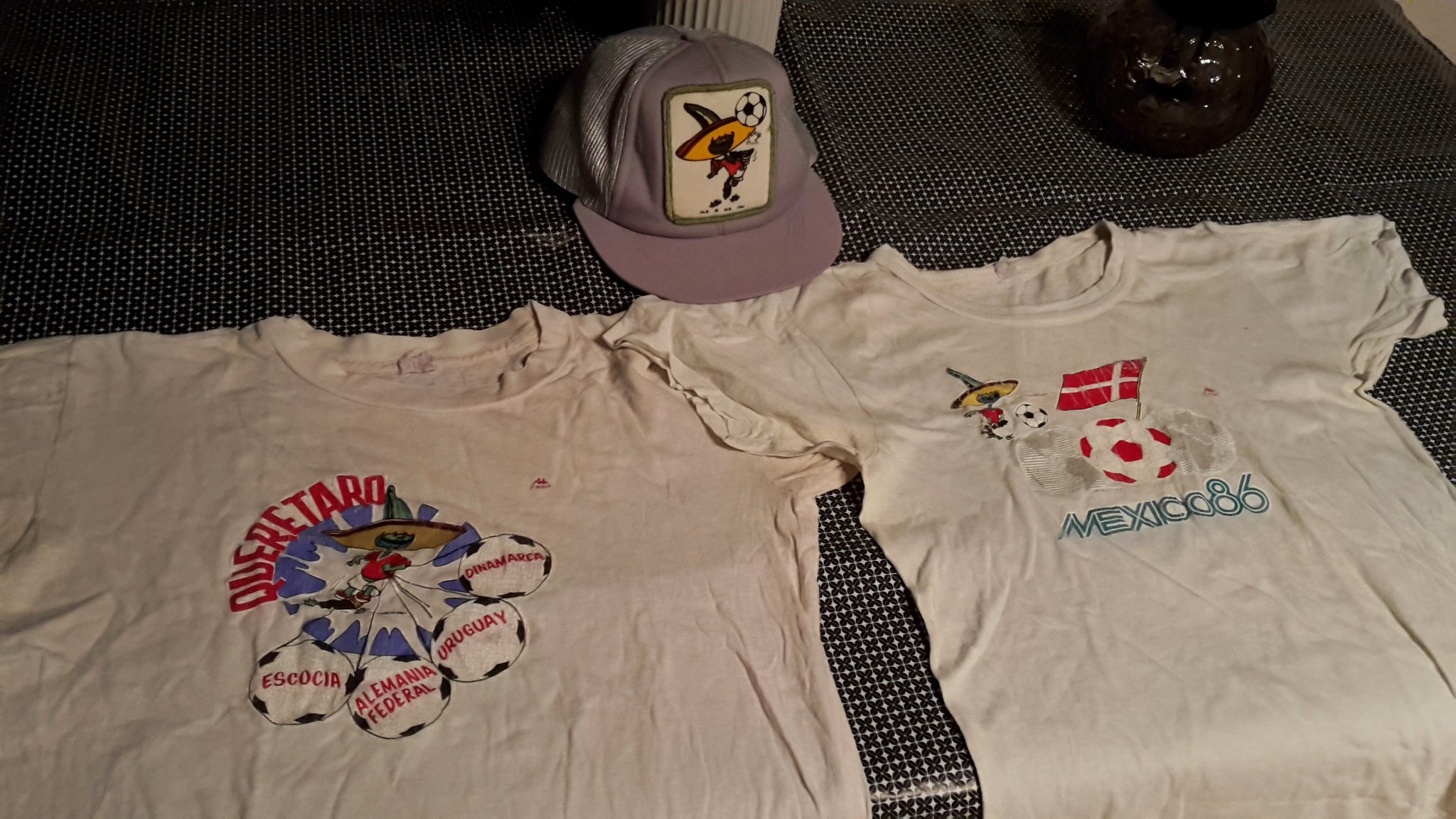
So it was interesting when recently I came over some old t-shirts and a cap purchased right before the World Cup:
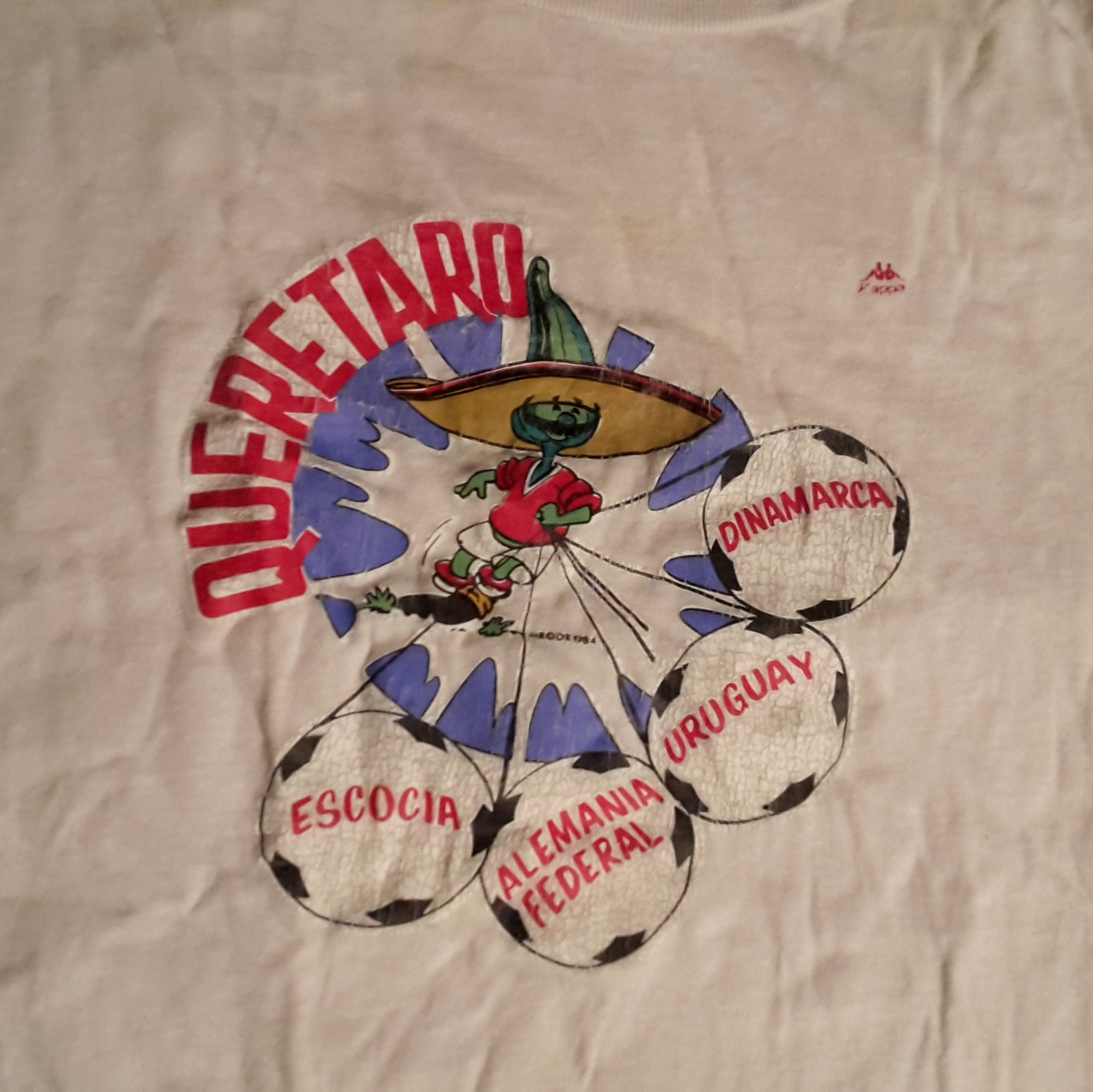
One of the t-shirt had the teams of group E:
A memorable group won by Denmark (it was their first World Cup) and followed by the later finalists of West Germany. Who would have thought this group was going over to history?
The t-shirts are old and too small for me today, but certainly remain an old memorabilia worth keeping for a football World Cup history fan!

Wednesday, March 10, 2010

Greatest World Cup Matches: Argentina-West Germany (1986)

The World cup in Mexico in 1986 is perhaps the best world cup in terms of the sheer number of quality teams, players, and intense matches: Italy and Poland were giants in decline; Brazil, France, West Germany and the USSR all had some of their best teams ever, while smaller footballing nations such as Denmark, Belgium and Morocco, had some of their best squads ever. In this conundrum of great matches, one man nevertheless stood out from all of them: Diego Maradona, who at the time unquestionably was the best player in the world, captained a strong Argentina side to rise above all the others, and were in the final against West Germany in Azteca stadium in Mexico City.
If anything, compared to the other great teams, Argentina was the most stable team, and all players, besides Maradona, performed excellently: the Real Madrid striker Jorge Valdano had scored three goals, Jorge Burruchaga from Nantes was extremely strong in midfield, while the defence organization around River Plates’ Jorge Ruggeri, Jose Luis Brown and Sergio Batista was probably the best of the tournament. In the first round Argentina had started by tying 1-1 with the defending world champions of Italy, while defeating South Corea and Bulgaria. In the last-16 they had met their eternal arch-rivals from Uruguay, whom they defeated 1-0. In the quarter-final Argentina defeated England 2-1 in a controversial match, where Maradona scored both goals, one being the infamous hand-of-God goal, and another that has been hailed as the best goal in world cup history. In the semi-final Maradona again scored two beautiful goals to give Argentina a 2-0 victory over Belgium and a place in the final.

In Spain in 1982 the German team had been extremely unpopular. In Mexico, the Germans were not particularly popular either, with a cynical and result-oriented style: in the first round they had progressed behind Denmark, after tying to Uruguay, defeating Scotland 2-1 and then losing 2-0 to the Danes. With second place, the Germans had avoided playing against the strong Spanish in the last-16 (whom the Danes lost 5-1 to), and instead faced Morocco, whom they were somewhat lucky to defeat 1-0 on a late strike by Lothar Matthäus and excellent goalkeeping by the 1982 villain, Harald “Toni” Schumacher.
Schumacher also took the headlines in the quarter-final against the Mexican hosts: in a boring 0-0 match, Schumacher made two consecutive saves on the penalty shoot-out to give West Germany a 4-1 victory.
The semi-final was a repeat of the 1982 legendary quarter-final between France and West Germany. Although the French were now the favourites, West Germany played their best match of the tournament and won 2-0, qualifying for their second consecutive World Cup final, after losing the 1982 final to Italy.

Argentina were favourites as the teams walked onto the pitch, not least because of Maradona, who had scored four goals in the previous two matches before the final. Knowing this, the Germans would aim their entire tactics on neutralizing Maradona, by putting the outstanding Bayern Munich midfielder Lothar Matthäus to mark him. But before the match the Argentinean coach Carlos Bilardo had expected the Germans to mark Maradona, and predicted that the match would be decided in the duel between Real Madrid’s striker Jorge Valdano and Hellas Verona’s defender Hans Peter Briegel.
And in the shadow of Maradona, the other Argentinean players stepped in to show that they would be worthy world champions. The first half hour of the match completely belonged to Argentina, who after 22 minutes went ahead by 1-0 on a header by the veteran defender Jorge “Tata” Brown, after a free-kick taken from the right-hand side by Jorge Burruchaga. Harald Schumacher, who had otherwise been the best goalkeeper of the tournament, completely mistook the trajectory of the ball, and let the Argentinean defender score.
Brown had been doubtful for the final due to a serious shoulder injury, but had insisted on playing, and this was the only goal he ever scored on the national team.
The Germans now had to step forward, but were still losing 1-0 at half-time.
Entering the second half the West Germans put the Werder Bremen striker Rudi Völler onto the pitch for Klaus Allofs, signalling that they would start attacking. However, 10 minutes into the second half, Argentina went ahead 2-0: Maradona and River Plate’s Hector Enrique combined quickly, and caught the advancing German defence on the wrong side of the off-side trap as Jorge Valdano pushed forward. Valdano ran directly toward the goal and coldly placed the ball to the left of Schumacher.
Everything seemed to go Argentina’s way, but as everyone knows, the Germans never give up.
West Germany’s coach Franz Beckenbauer now put on an extra striker, Bayern Munich’s veteran Uli Hoenness, and started pressing forward against the Argentineans who seemed to think the match was over, as Valdano admitted afterwards, “we thought we were already world champions…”
In the 73rd minute another Bayern Munich veteran, Karl-Heinz Rummennigge pulled one back for West Germany after a corner-kick, where the Argentinean defence looked to stand still as Rummennigge lurged forward in front of the goal inside the Argentinean area.
Eight minutes later West Germany had a corner-kick from the exact same place as the previous goal, but this time it was kicked towards the far post, where Thomas Berthold headed the ball into the six-yard box; a completely unmarked Rudi Völler came forward and headed the ball into goal.
2-2, and Argentina seemed to have thrown it all away withing ten minutes.
However, only four minutes later Maradona, who closely marked had been quite anonymous the entire match, showed one moment of brilliance when he made a perfect through-pass to Jorge Burruchaga at the very moment when Hans-Peter Briegel was pushing forward to put the player off-side. Burruchaga rushed towards goal with a desperate Briegel behind him, and put his shot under Schumacher before Briegel could tackle.
Argentina was now ahead 3-2, and were now confident that in the final six minutes, the Germans would not get back into the match.
West Germany had lost its second consecutive World Cup final, while Argentina had won its second World Cup title. In the eight years since the previous title in 1978 Argentina had undergone significant changes, become a democracy, and this victory seemed sweeter amid the controversies of the 1978 victory. There was no doubt that Argentina, led by Maradona, had been the best team of the tournament.

Match Stats:
  • 29th June, 1986, Estadio Azteca, Mexico City
  • Attendance: 114,590
  • Referee: Romualdo Arppi Filho (Brazil)
Argentina-West Germany 3-2
Goals: 1-0 Brown (22), 2-0 Valdano (55), 2-1 Rummenigge (73), 2-2 Voller (81), 3-2 Burruchaga (84)

Teams:
Argentina: Pumpido, Cuciuffo, Brown, Ruggeri, Olarticoechea, Batista, Giusti, Enrique, Burruchaga (Trobbiani), Maradona, Valdano
West Germany: Schumacher, Brehme, K.H. Forster, Jakobs, Briegel, Eder, Matthaus, Magath (Hoeness), Berthold, Allofs (Voller), Rummenigge

Monday, March 01, 2010

Greatest World Cup Matches: Argentina-England (1986)

The quarterfinal of the 1986 World Cup between Argentina and England was immersed in a bitter football and political rivalry between the two countries. In football terms, the rivalry had started in the 1966 World Cup where the English coach Sir Alf Ramsey had called the Argentinean animals. In political terms, the two countries had only three years before ended a short but bloody war over the Falklands Islands in the southern Atlantic.
Although the players denied that the political situation had any influence on the match, the coaches of both teams, Carlos Bilardo and Bobby Robson, told the players not to mention the Falklands, and only talk about football. However, specially the Argentineans could not take the war off their mind, and Maradona later said: "Although we had said before the game that football had nothing to do with the Malvinas war, we knew they had killed a lot of Argentine boys there (…). And this was revenge."
The mid 1980s were a period of crisis for English football, not least for their violent followers, who in 1985 for the European Champions Cup final between Liverpool and Juventus at Heysel had caused the death of 85 fans. This had led to English clubs being banned from international competition, but their national team still competed, albeit under very strict security measures.
England had not started the tournament well, losing to Portugal 0-1 and playing 0-0 with Morocco before securing the second place in their group (behind Morocco) with a 3-0 victory over Poland, in a match where the Everton striker Gary Lineker had scored all three goals.
In the last-16 the English had faced Paraguay, and had won 3-0 on two more goals by Gary Lineker and one by the little Liverpoool star Peter Beardsley.
Argentina had started the tournament very well: a very strong defense and the world’s best footballer, Diego Maradona, had helped them to win their first round group after tying 1-1 with Italy’s defending world champions, and defeating Bulgaria and South Corea. In the last-16 the Argentineans defeated their arch-rivals from Uruguay 1-0, and were now to play England in what became a hugely anticipated match.
Both teams seemed nervous at its importance as the match got underway in the monumental Azteca Stadium in Mexico City. The English perhaps had too little respect for the Argentinean side, and notably Maradona, as the Argentineans slowly started dominating, and had some good chances for bringing themselves ahead, although Peter Beardsley had a god chance when the Argentinean goalkeeper Neri Pumpido made a mistake.
Still, the score was 0-0 at half-time.
Six minutes into the second half came one of the most controversial and infamous moments in World Cup history: Maradona and Valdano were attempting a combination outside the English area, but the Aston Villa defender, Steve Hodge, blocked the pass. However, Hodge hit the ball completely wrong, and it flew backwards high into the English penalty area. Maradona continued his run into the area, against goalkeeper Peter Shilton, and they both jumped for the ball coming down. Maradona, significantly smaller than Peter Shilton, reached the ball with his left hand, and it sailed above Shilton into the English goal.
The English immediately protested to the Tunisian referee Ali Bin Nasser, while the Argentineans celebrated the goal. As the entire world saw the hand on replays on TV while the English players protested, Bin Nasser was surely the only person in the world that had not seen Maradona’s hand. But he was the one who had to make the decision.
Argentina was ahead 1-0, and the English felt cheated, while Maradona famously and ironically said after the match that it had been with a little help from “the hand of God”, something that greatly angered many of the normally so satirically humoured Englishmen.
Maradona had cunningly humilliated England, and that is how all Argentina fans (including myself, who living in Argentina then, was and is an unrepentant Argentina and Maradona fan!) still see that goal in spite of the controversy it arises.
In any case, Argentina was now ahead because of the world’s best footballer’s cheat, but only three minutes later Maradona showed that he was unique, when scoring what has been considered the goal of the century. Receiving the ball from River Plate’s Hector Enrique (who after the match joked that Maradona could not avoid scoring on such a great pass!) in his own half, Maradona made the most stunning rush of 60 meters, past six English players, including Peter Shilton, to score a second for Argentina.
All over the world the goal is legendary. Jorge Valdano has called it another way of tango - of beauty. The Argentinean commentator Victor Hugo Morales perhaps symbolized the sensation for Argentineans as his emotive screams of goals, and his “…Thank you God, for football! For Maradona! For... for these tears…. For this... Argentina 2, England 0.
Even the English, in spite of bitterness of the first goal, had to recognise the pure genious of the second goal, as the great Gary Lineker later recalled: "The second goal was, and still is, the best goal ever scored. You have to take into account the significance of the football match and the conditions, as it was unbelievably hot and we were playing on a pitch that moved every time you put your foot down. It was pretty unplayable. To do what he did was just extraordinary. I have to say I just stood there on the halfway line and thought, 'Wow'."
England now had to push forward, and suddenly began playing less timidly. The entrance of Liverpool’s John Barnes, helped the Islanders to create some chances against the otherwise very strong Argentinean defense, but it was only nine minutes before the end of the match when Gary Lineker scored his sixth goal of the tournament (making him the most scoring player of the tournament) on a cross from Peter Beardsley.
But it was not enough. The ever-dangerous Argentineans even hit the post a few minutes later on some of the counter-attacks that they were so brilliant at.
Argentina had won 2-1, and went on to win the World Cup by defeating Belgium and West Germany in the following two matches. However, for many people, this was the real final, where the controversy and genious of Maradona reached its pinnacle.
England and Argentina are two of the greatest footballing nations in the world. Perhaps in no other nation the passion about football is as deep-seated as in these two countries.
After this match in particular, they now have the greatest rivalry in international football (the only cross-continental rivalry) and the matches between them are considered a classic in international football.

Match Stats:
  • 22nd June 1986, Estadio Azteca, Mexico City
  • Attendance: 115,000
  • Referee: Ali Bin Nasser (Tunisia)
Argentina-England 2-1
Goals: 1-0 Maradona (51), 2-0 Maradona (54), 2-1 Lineker (81)

Teams:
Argentina:
Pumpido; Ruggeri, Batista, Brown, Burruchaga (Tapia), Olarticoechea, Cuciuffo, Enrique Giusti, Maradona, Valdano
England: Shilton; Stevens, Sansom, Hoddle, Butcher, Lineker, Fenwick, Reid (Waddle), Steven (Barnes), Hodge, Beardsley

Thursday, February 25, 2010

Greatest World Cup matches: Brazil-France (1986)

Brazil’s squad for Mexico in 1986 included players from one of the most gifted generations of Brazilian football, that had nevertheless been humbled by Paolo Rossi and Italy in the 1982 World Cup. Among these players were Torino’s Junior, one of the best fullbacks in Brazilian football; Flamengo’s Zico, one of the best Brazilians of all-time; Flamengos’ legendary and charismatic midfielder Sócrates, as well as the ageing Falcão, who was finishing his career in São Paulo.
The 1986 World Cup in Mexico was the last chance for this golden generation to lift the trophy. The squad was nevertheless also supplemented by some good young players, among them the outstanding defenders Branco from Fluminense and Julio Cesar from Guaraní, as well as the dangerous São Paulo striker Careca.
The Brazilians had started the tournament well with three consecutive victories in the first round against Spain, Algeria and Northern Ireland. In the last-16 they had defeated an ageing Polish side 4-0, but the true test of their strength would come against the European champions of France in the quarterfinals.
France, who had reached the semifinals of the 1982 World Cup arguably had one of the best teams in the world. In 1984, at home, they had been awesome in taking the European championship, where the Juventus star and three-time European player of the year (1983, 84 and 85) Michel Platini had been absolutely outstanding.
Platini was nevertheless not alone, as he presided over what was dubbed “the magic square” (Carré Magique) on the French midfield, composed of Platini himself, the superb Alain Giresse from Bordeaux, and the defensive midfielders Jean Tigana, also from Bordeaux, and Luis Fernandez from Paris Saint-Germain. In defence the French had one of the best defenders of his age, Monaco’s Manuel Amoros, as well as the veteran Nantes’ player Maxime Bossis.
The French had not been that strong in their first matches though, where they had only managed a 1-0 victory against Canada on a late goal by the young Jean-Pierre Papin, then tied 1-1 with the strong USSR and defeated the poor Hungarians 3-0. In the last-16 the French had been faced with the defending world champions of Italy, whom they had defeated 2-0, and were now to face Brazil in one of the most anticipated quarterfinals of the tournament: Brazil and France were two of the best teams in the world in 1986, both playing exhilarating and entertaining football.
The match was no disappointment, and although it perhaps lacked goals, it was one of the best displays of technical skill, attacking football and pace in World Cup history.
The match started at a fast pace, and only after a few minutes Manuel Amoros had an excellent shot from outside. Manuel Amoros would in fact be at the center of the action, playing an outstanding match in defence as the Brazilians attacked again and again. After 17 minutes, following quick combinations between Muller and Junior, the latter found Careca alone at the edge of the area, and the São Paulo striker made no mistake in bringing Brazil ahead.
Brazil continued attacking, and the French defenders fought well, although also with some luck, as when Muller hit the woodwork. However, France patiently worked themselves into the match, and after 41 minutes Dominique Rocheteau centered from the right side. The ball was slightly deflected by a defender, as Yannck Stopyra crashed into the Brazilian goalkeeper Carlos trying to get a header, but with both missing the ball. On the far post, Michel Platini had no problem pushing the ball into an empty goal, as Carlos and Stopyra lay in the center.
The score was 1-1 at halftime.
Both teams opened up more in the second half, and seeking goals, both teams had good chances, although Brazil came closest, with Careca hitting the post on an excellent header. But as the match advanced and nothing happened, the Brazilian coach Tele Santana decided to change Muller for the legendary Zico, who had started the match as a substitute. And after only five minutes the ageing Brazilian took center stage: a perfect through-ball to Branco forced the Paris Saint-Germain goalkeeper Joel Bats to make a penalty. The experienced Zico was to take it, but shot poorly against the experienced Bats (who is still considered one of the best French goalkeepers of all time), who saved.
Brazil had seen victory within their reach, but the match ended 1-1, and went into extra time.
Although the players were tired after 90 minutes in the hot Guadalajara sun, both teams still sought victory, with the best chance coming to France’s striker Bruno Bellone, who had come on as a substitute for Rocheteau. Alone with Carlos, the French goalkeeper clearly went for Bellone, who out of balance from Carlos foul missed his chance.
Scandalously, the Romanian referee Igna didn’t do anything against this clear foul.
Thus, the extraordinary match would have to be decided by a nerve-wrecking penalty shootout.
One of the greatest stars, Zico, had missed a penalty. Now, Brazil’s captain, Sócrates, was to shoot the first penalty for Brazil, and his shot was also spectacularly saved by Bats. All the advantages were now with France. At the score 3-3, Michel Platini had to shoot for France to bring them ahead; with his experience and technique, it was a surprise when he shot over goal, levelling the shoot-out to the relief of the Brazilians.
All the super-stars seemed to be missing penalties!
It was then the turn of the defender Julio Cesar, who at the time was playing in the French club Stade Brestois 29, to shoot. His hard shot hit the post, and the score was levelled again before the last player went to shoot: Luis Fernandez, the experienced Paris Saint-Germain midfielder made no mistake in scoring the winning penalty for France on a low shot to the right of Carlos.
Zico and Sócrates would never be world champions, this being their last World Cup. In the meantime, the French had proven strongest against the toughest opposition, and emerged from this match as favorites for the world cup title together with Argentina. However, in the semifinal France was to face their eternal nightmare, West Germany. And just as had happened in 1982, West Germany proved to be too clever for the French, who had to return to France with bronze medals.
France and Brazil in 1986 were two of the best teams ever never to win a world championship, but still gave the world a wonderful match in their quarterfinal. All men on that pitch that day went far beyond being athletes, but became artists.
I was not old, but remember watching this match and being in awe at the speed, quality and intensity. It was true football beauty all the way through, and I think I still remember the match as the best I have ever watched.

Match Stats:
  • 21st June 1986, Estadio Jalisco, Guadalajara
  • Attendance: 65,000
  • Referee: Ioan Igna (Romania)
Brazil-France 1-1 (After extra time)
Goals: 1-0 Careca (17), 1-1 Platini (40)

Penalty kicks:
Brazil-France 3-4
Socrates missed for Brazil
0-1 Stopyra
1-1 Alemão
1-2 Amoros
2-2 Zico
2-3 Bellone
3-3 Branco
Platini missed for France
Julio Cesar missed for Brazil
3-4 Fernandez

Teams:
Brazil: Carlos, Edinho, Junior (Silas), Julio Cesar, Alemão, Branco, Socrates, Elzo, Muller (Zico), Josimar, Careca
France: Bats; Amoros, Battiston, Bossis, Tusseau, Fernandez, Platini, Giresse (Ferreri), Tigana, Rocheteau (Bellone), Stopyra

Saturday, February 20, 2010

Greatest World Cup matches: Morocco-Portugal (1986)

African nations were late entrants into the World Cup. Morocco participated in 1970, and Zaire in 1974 with pathetic results. In 1978 Tunisia was the first African team to win a match in a World Cup when they defeated Mexico 3-1, and in 1982 two African teams, Cameroon and Algeria, had extraordinary results but without qualifying to the second round. By 1986 it thus seemed only a question of time before African teams would qualify to the second round.
In Mexico, in 1986, two African teams participated: Algeria and Morocco. While the Algerians fell in the first round in a difficult group with Brazil, Spain and Northern Ireland, Morocco unexpectedly went on to become the first African team to win a group in a world cup, ahead of three strong European sides, England, Poland and Portugal.
In their first two matches Morocco had first tied 0-0 with the 1982 bronze winners from Poland, and then tied 0-0 with England. In the meantime, Portugal had defeated England 1-0 and lost 1-0 to Poland, and thus apparently had good chances of progressing to the next round against the still-underestimated Moroccans. Built around players from the two major clubs in Portugal, Benfica and FC Porto, Portugal was participating in only its second World Cup since 1966, and had been the first to defeat West Germany away in a qualifier.
However, the Portuguese team had been surrounded by scandals up to the World Cup: a Benfica player on the squad, Antonio Veloso, had been suspended for doping and the players had during the preparation threatened to strike, as they were not satisfied with the prize money. This created great instability on the team, that was somewhat considered the joke of the tournament.
In spite of all this circus, they were still considered favourites against the Moroccans.
Morocco were coached by the Brazilian José Faría, and mainly consisted of a solid core of players from Moroccan clubs, notably the champions FAR Rabat, supplemented with some players from second-tier European clubs, such as Valencienne’s Mustafa Merry, Le Havre’s Abdelkrim “Krimau” Merry and Laussane’s Moustaffa El Haddaoui. Their star was undoubtedly the outstanding Mohammed Timoumi from FAR Rabat – African Player of the year in 1985.
The last two matches of the group, England-Poland and Morocco-Portugal were played at the exact same time, and all four teams had a chance at qualifying for the next round.
There was little doubt that the Portuguese were expecting a victory.
Morocco completely overran the Portuguese from the start of the match in front of 24,000 in Guadalajara. After 19 minutes the FAR Rabat striker Abderrazak Khairi picked up a return ball outside the Portuguese area and was given space by the Portuguese defense to score on a good long-range effort.
Only seven minutes later the defender Labid Khalifa centered from the right side into the Portuguese area. The ball drifted down towards the far post where Khairi, completely unmarked, came rushing from behind, and in perfect control first-timed the ball into the Portuguese goal.
2-0 down the Portuguese apparently realised that they were heading out of the tournament, but were unable to really put pressure on the well-organised and confident Moroccan side. First half ended 2-0, and halfway into the second half the Moroccans sealed their outstanding victory: combining excellently, Mohammed Timoumi received the ball on the left side. With the Portuguese defense caught off-hand, he saw “Krimau” Merry pushing forward in the center, and made a perfect pass that Merry controlled perfectly and shot before he could be reached by a Portuguese defender.
The Moroccans somehow relaxed after this, while the Portuguese were clearly disillusioned. It didn’t matter that Benfica’s Diamantino, ten minutes before time, scored a consolation goal for Portugal on a somewhat coincidental chance, but it made no difference for Morocco’s achievement: as England defeated Poland 3-0, it was clear that Morocco were group winners in front of England. Portugal ended last in the group and had to return to much criticism in Portugal.
Morocco faced the later finalists of West Germany in the last-16, and lost 1-0 on a late goal by Lothar Matthäus.

Match Stats:
  • 11th June 1986, Estadio Tres de Marzo, Guadalajara
  • Attendance 24,000
  • Referee: Alan Snoddy (Northern Ireland)
Morocco-Portugal 3-1
Goals: 1-0 Khairi (19), 2-0 Khairi (26), 3-0 Merry Krimau (62), 3-1 Diamantino (80)

Teams:
Morocco: Badou; Khalifa, Lamris, El Biyaz, Bouyahyaoui, Dolmy, Moustaffa El Haddaoui (Soulaimain), Bouderbala, A. "Krimau" Merry, Timoumi, Khairi
Portugal: Damas; Antonio Sousa (Diamantino), Alvaro (Rui Aguas), Carlos Manuel, Pacheco, Frederico, Gomes, Futre, Jaimes Magalhães, Oliveira, Inacio

Thursday, June 29, 2006

Brazil-France World Cup clashes

On Saturday Brazil and France will play their fourth encounter in a World Cup. They have always played exciting matches, with France so far having won twice, and Brazil once. The matches have been the following:
  • Semifinal, Sweden 1958: France had an extraordinary side with Raymond Koppa and Just Fontaine. The latter is still the player to have scored most goals in one World Cup, with 13 in this one year. In the semifinal however, they were up against one of the most legendary Brazilian sides of all time. Brazil won 5-2, and later became World Champion against Sweden. One young 17-year old Brazilian scored three goals to defeat the French: Pele.
  • Quarterfinal, Mexico 1986: Brazil and France were filled with some of the World's most talented players, and in this quarterfinal played one of the most entertaining matches ever seen in a World Cup. It ended 1-1 in ordinary time, althoguh 5-5 would probably have been a more fair score. Legendary Brazilian Zico missed a penalty 10 minutes before the end of the match, and after extra time, France won on penalty kicks.
  • Final, France 1998: France had never been World Champions until they hosted it this year. In the final they were to face the defending champions of 1994, Brazil, who had had a quite mediocre performance, but nevertheless made it to the final. However, the Brazilians were no match for the motivated Frenchmen, who crushed Brazil 3-0 in one of the most uninteresting finals of all time.

I am certain that the quarterfinal match on Saturday will be another for the history books. France is motivated after their win against Spain, while Brazil has been looking vulnerable until now. The game could go to either side.

Monday, June 26, 2006

Great Quarterfinals

The first matches of the last-16 were played this weekend. Germany was excellent against a tame Swedish side, although they only won 2-0. Sweden has really been one of the most over-estimated side of the torunament, and will hardly be missed.
Argentina-Mexico was as expected, a difficult match for the Argentinians. The Mexicans, who have not been very impressive, put up a good match against Argentina, who was somewhat disappointing. However, Maxi Rodriguez gave Argentina the victory with a stunning strike! One of the best goals of the tournament.
Now, we will get a classic clash in the quarterfinal: Germany-Argentina! Not only is is a repeat of the 1986 and 1990 World Cup finals, but it is also a game between two of the favourites for the title. It is an encounter every football fan will wait for. And I hope Argentina prevails...

England was again not impressive against little Ecuador, although winning a narrow 1-0. Two things saved England: Ashley Cole's tackle in the first half, and David Beckham's great free-kick. As before, England needs to play much better if they are to hope to defeat any of the big teams.
Portugal-Netherlands was a true knock-out drama, ending in disgrace for both teams. Netherlands confirmed that in spite of many great players, they have not managed to pull a team together at all - making you wonder about Dutch football. The Portuguese won, but it was a hard won victory, ending in disgrace: two red cards for each game, and Portugal will be missing Deco, Costinha and Cristiano Ronaldo against England. In spite of this, England-Portugal promises to be another drama, a repeat of their quarterfinal clash in the 2004 European Championship, where Portugal won a dramatic victory after penalty kicks.
The best thing for now about this World Cup, is that we are getting these huge classic encounters in the quarterfinals. Already a Spain-France tomorrow, and possibly a Brazil-Spain in the quarterfinals! This is football for giants!

Saturday, September 25, 2004

Top Ten World Cup goals

As I had just been thinking about my favourite top-ten world cup goal celebrations, the natural thing occured, that I should also publish my top-ten favourite world cup goals.
This is a bit hard though, as it is very personal on the one hand, and on the other, there are so many... But here it is:

1) Maradona's second goal against England, 1986: A true classic, when The Master himself strolled through half the English team, to score a great and important goal.
2) Dennis Bergkamp, in the quarterfinals Netherlands against Argentina, 1998: a long pass into the Argentina area is taken down superbly by Mr. Bergkamp, and he scores a glorious goal.
3) Eder, Brazil, against the USSR in 1982: I was young, and very impressed by the little tip Mr. Eder gave the ball, before hammering it in from afar, behind a surprised Mr. Dassaev.
4) Michael Owen, England quarterfinal against Argentina 1998: Mr. Owen was only 17 years old when he fought through the Argentine defense with speed power and talent!
5) Jorge Negrete, Mexico against Bulgaria 1986: a classic and gorgeous bycicle kick. Usually it was Mr. Hugo Sanchez doing them, but Mr. Negrete showed he could as well.
6) Owairan from Saudi Arabia against Belgium in 1994: It was a surprising victory for Saudi Arabia, after a wonderful goal by Mr. Owairan, in which he showed technical superiority by strolling through the Belgian team.
7) Claudio Canniggia, against Brazil 1990: Only attack by Argentina in the game, in which Maradona made a superb pass to Canniggia, who struck like a lightning.
8) Iordan Letchkov against Germany in the quarterfinal 1994: A great header which gave Bulgaria a spot in the semifinals.
9) Michael Laudrup, Denmark, against Uruguay, 1986: A brilliant Danish side, with a 21-year old Michael Laudrup, who danced through the Uruguayan defense and scored from a very sharp angle.
10) Carlos Alberto, Brazil 1970 final against Italy: This goal is a classic in the Brazilian combinations. With a short pass from Pelé, Carlos Alberto hammered the ball into the net.

There are many other goals though, which I knowingly have taken out, but which would very much deserve a place in such a list:
-A young Pele's beautiful tip over a defender in the WC final against Sweden, 1958
-Allchurch's amazing first-timer when scoring for Wales against Hungary in 1958.
-Just Fontaine in the semifinal against Brazil in 1958, when he combined beautifully with Raymond Koppa.
-Kurt Hamrin's classic goal for Sweden against West Germany in the 1958 semifinal.
-Jairzinho's hammer against England in 1970, after combining with Tostao and Pelé.
-Archie Gemmill from Scotland, against the Netherlands in 1978 .

There are so many!!! Anyone is more than welcome to add more!