Showing posts with label world cup 1990. Show all posts

Wednesday, March 31, 2010

Greatest World Cup matches: West Germany-Argentina 1990

The end of the 1980s and early 90’s were a time of great changes in the world as well as in the world of football. The 1980s had seen violence around the game grow, culminating in the specter of hooliganism and banning of English teams to play in Europe. Football had become a catalyst for the ugliest sides of European nationalism. On the pitch football had growm much more defensive and accepting of unfair play and horrible tackles.
Sadly, the World Cup of 1990 assembled all of these forces: “Italia 90 condensed the new social forces remaking European football: saturation media coverage, high commercials takes and the repackaged spectacular. It was perhaps the most gruelling, defensive and mean-minded tournament yet staged.”
The atmosphere at the World Cup in Italy was from the start hateful and very nationalistic, and the teams participating living off this like vultures. Foul play was ignored or even glorified in the case of Cameroon, Argentina or Italy, as long as victory was achieved.
On the pitch fans saw the World Cup with the lowest goal-scoring average ever; most teams, notably Argentina, Italy and Ireland played immensely defensive football. There was only one match where both teams scored more than one goal, with most penalty kick decisions and a record in the number of red cards.

It was the worst World Cup ever played, and the final was no exception: it is widely regarded as the worst final ever played as West Germany defeated Argentina 1-0 to win their third world title in a repeat of the 1986 final, when Argentina had won.
It was thus time for revenge, and the entire atmosphere around the final was hugely hateful and negative. Argentina had during the entire tournament played very defensively and negative football, reaching the final on the moments of glory of Diego Maradona and Claudio Cannigia, as well as spectacular goalkeeping by Sergio Goycoechea. Diego Maradona, who had become a controversial superstar in Italy while playing for Napoli, was particularly the target of a European media and fans who saw little tolerance in a star from a Third World country who was very provocative and immersed in scandals, but yet brought glory to every little team he played for, like the ever-discriminated city of Naples in southern Italy.
Maradona was hated in Europe, and this World Cup was Europe’s reckoning in the country where Maradona had shined for Napoli.
Argentina only added to the hate by playing destructive football, although their sensational defeat to Cameroon in the opening match had been as much due to harsh play by the Africans. In any case, Argentina made it through to the last-16 barely, and meeting Brazil they won 1-0 as sensationally as they had lost to Cameroon in a match where Brazil had all the chances in the world. In the quarterfinal Argentina defeated the splendid Yugoslav side (playing their last World Cup as a unified country) after penalty kicks where Sergio Goycoechea had saved two penalties. In the semifinal the Argentineans had again sensationally defeated the home team of Italy in Naples after penalty kicks, and were in spite of their unpopularity, destructive play and poor playing ready to defend their World Cup title in Rome.

West Germany was also playing its last World Cup: in November 1989 the Berlin wall had fallen, and soon the two Germanies would unite to form one Germany. Although Germany still awakened much fear in Europe and few people particularly supported them, there was no doubt that they had been the best team of the tournament.
In 1982 and 1986 the German national side had been one of the least popular sides, but making two World Cup finals. In 1990, as most other great teams were either destructive or inefficient, the Germans emerged as an outstanding side, captained by one of the best players of all time, the all-round Inter and former Bayern Munich star Lothar Matthäus, the West Germans had surely emerged as the (for many grumbling) stars of the tournament.
The Germans started the tournament by destroying Yugoslavia and the United Arab Emirated 4-1 and 5-1 respectively, and a 1-1 with Colombia was enough for them to win the group. In the last-16 the Germans defeated the defending European champions of the Netherlands 2-1 in a dramatic match, and in the quarterfinals Czechoslovakia (also playing their last World Cup as a united country) were defeated 1-0 on a Lothar Matthäus penalty goal.
In the semifinal the West Germans faced their eternal English rivals in what for the English was the best World Cup since 1966. In a tense match that ended 1-1, West Germany won after extra time, and although they were not playing splendid football, they were certainly the favourites in the final against Argentina.
To illustrate the hateful atmosphere of the tournament, thousands of fans disrespectfully booed through the Argentinean national anthem before the match. The Argentineans (without some of their best players, notably Claudio Cannigia who was banned for the final) saw their only chance in winning by playing destructively, while the German team was unable or not good enough to break through the defense, as well as being afraid of making mistakes the Argentineans were so good at taking advantage of.

It was a horrible final, and in spite of the Germans having more possession, nothing happened. First half ended 0-0, and there were hardly any chances in the second half either.
Halfway through the second half the Independiente defender Pedro Monzón, who had come on as a substitute for Oscar Ruggeri, received a red card by the Mexican referee Eduardo Codesal for a challenge on Jurgen Klinsmann.
It was the first time a player was sent off in a World Cup final, further underlining the negativity of this tournament.
Down to ten men Argentina continued defending without the Germans getting any clear chances. It was obvious that the South Americans were hoping to win like they had done in the previous two matches, by penalty kicks, counting on their outstanding goalkeeper. But only five minutes before the end Eduardo Codesal awarded the Germans a very friendly penalty kicks on a challenge on the splendid Roma striker Rudi Völler. The defender from Inter, Andreas Brehme, who had previously scored on free kicks against the Netherlands and England, scored on a well-shot penalty, although Goycoechea had seen its direction.
The penalty was enough to make West Germany world champion, but before the match another Argentinean, Cremonese’s Gustavo Dezotti was harshly sent off as the second player ever to receive this dubious honour in a World Cup final.
There was enormous criticism of the Mexican referee in Argentina in particular, as his decisions clearly favoured the Germans. That said, as a whole, West Germany was without a doubt the best team of the tournament and the right world champions, although it is overshadowed by the poor tournament and absolutely horrible final.
The German coach Franz Beckenbauer, who had captained the German winning side in 1974, became the second person ever to win the World Cup as both as a coach and a player (the first being Mario Zagallo for Brazil in 1958 and 1970).

In spite of all this, any football fan was only looking forward to improvement of the game that had sunk to its lowest in Italy. The 1994 World Cup in the USA was fortunately a rebirth of football both in the sense of the fans (who in USA showed a new friendly side) and in the way of the game, as new teams (some of the great ones as England and France did not qualify), new rules and new tendencies greatly promoted the renewal of football.
The 1990 final is one of the greatest matches of all time, but not for positive reasons.

Match Stats:
  • 8th July, 1990, Stadio Olimpico, Rome
  • Attendance: 73,603
  • Referee: Eduardo Codesal (Mexico)
West Germany-Argentina 1-0
Goals: 1-0 Brehme (85) (pen)

Teams:
West Germany: Illgner, Brehme, Kohler, Augenthaler, Buchwald, Berthold (Reuter), Haessler, Littbarski, Matthaus, Klinsmann, Voller
Argentina: Goycoechea, Ruggeri (Monzón), Simon, Lorenzo, Serrizuela, Sensini, Burruchaga (Calderon), Basualdo, Troglio, Dezotti, Maradona

Thursday, March 25, 2010

Greatest World Cup matches: Italy-Argentina (1990)

Diego Armando Maradona had been the uncontested football star of the 1980s, and is perhaps the best player that ever lived. In 1986 he had led the Argentinean team to the World Cup, and had changed club from FC Barcelona, where he had not had a happy spell because of injuries, to AS Napoli as the then most expensive player in history. The move immediately paid off, as Maradona led the club to a long-awaited Serie A title, as well as a UEFA Cup title. He immediately became a legend in the southern Italian city, jealous of the success that had for so many years only gone to the rich northern Italian teams. But at the same time, Maradona was creating controversy; with his sometimes provocative personality and scandals surrounding him, he became a vilified person outside of Naples and Argentina. This came to a head in the 1990 World Cup, where the defensive Argentinean side won few friends. In the first round Argentina had sensationally lost the opening match in Milan to Cameroun, and the entire stadium in Milan had been against the Argentineans. In the two following matches Argentina just made it into the last-16 by defeating Russia and tying Romania. In the last-16 Argentina faced their arch-rivals of Brazil, and although pressed down the entire match, it only took one brilliant moment from Maradona and Claudio Canniggia to give them a 1-0 victory (and one of Brazil’s worse World Cup performances ever!).
In the quarterfinals Argentina had faced what at the time was perhaps the most powerful European side, but that was soon to be torn apart by war, namely Yugoslavia. In another defensive match, Argentina took the Yugoslavs into penalty kicks, where the Argentinean goalkeeper from Millionarios, Sergio Goycoechea (who had replaced the hapless Neri Pumpido, who had cost the losing goal against Cameroun) stepped forward and with four saves, gave the Argentineans the place in the semifinals, where they were to play the Italian hosts.
Italy clearly expected to be world champion at home. Everything around the tournament had been set up with this in mind, and in spite of some questionable refereeing and not always strong play, Italy had won every match; in the first round they had three narrow victories against Austria, USA and Czechoslovakia; in the last-16 Uruguay had been defeated 2-0, while Ireland had been defeated 1-0 in the quarterfinals. The star of the Italian team had been the small Juventus striker Salvatore “Toto” Schillaci. He had come in as a substitute in the first match against Austria and had scored the winning goal. After this he had started in every match taking over the position as striker with great success (he was to become the most scoring player of the tournament).
The match was to take place in Naples, in Stadio Sao Paolo, which was Maradona’s home stadium. After Argentina had been booed by fans wherever they went, the Argentineans really hoped that Maradona’sstatus as a legend in Naples would lead to people support them against the hosts. Maradona himself said: “For 364 days of the year you are considered to be foreigners in your own country. Today you must do what they want by supporting the Italian team. Instead, I am a Naepolitan for 365 days out of the year.”
The Naepolitans responded by clapping of the Argentinean team, and a huge banner in the stadium read: “Maradona Napoli loves you, but Italy is our country.” There was no conflict, and it was the only stadium where the Argentinean team was met with respect. While the Naepolitan fans did support their home country in what became a very dramatic match.
It all seemed to be going Italy’s way from the start as only one quarter of an hour into the match Italy was attacking and the Sampdoria striker Gianluca Vialli had a spectacular shot that Goycoechea could not hold, and the ball went directly to a quick Schillaci who a bit clumsily kicked the ball into the goal and an Italian lead. It did not matter that the Argentineans protested that at the moment of Vialli’s shot, Schillaci had been in an off-side position; this was a detail for an immensely home-friendly French referee, Michel Vautrot (although to be fair, it is still discussed whether such a situation should be an off-side nevertheless; they are called as often as they are not…).
However, working hard and giving the Italian strikers little space (often with unfair means) the Argentinean team slowly started working their way back into the match, and as this happened the Italians got increasingly nervous. It was not a beautiful match, but it was very intense, and for the Italians, growing evermore so as they lacked chances and the Argentineans were being led by a Maradona who was playing his best match of the tournament.
Nobody had scored against Italy in the tournament so far, but halfway into the second half the Atalanta striker Claudio Caniggia rose up to a cross into the Italian penalty area by Julio Olarticoechea, and got in front of Walter Zenga, who looking very fragile, saw the ball go over him and into the Italian net.
The frustration was clear among the Italians, and coach Azeglio Vicini decided to put in Roberto Baggio and Aldo Serena. Although they pressed more, the Argentinean defense around Real Madrid’s Oscar Ruggeri was very strong, and whenever the situation came, Goycoechea was being splendid on goal, for instance making a spectacular save of a free kick from Roberto Baggio.
As the match went into extra time the nerves only got worse and so did the numerous fouls. And the French referee only contributed to this when he put on a totally uncalled for extra time of eight minutes in the first half of the extra time. In this time, the Argentinean player from Independiente de La Plata received a red card for punching Roberto Baggio. However, up one man, Italy was unable to break the deadlock, and the match went into the penalty kicks that the Argentineans had hoped for.
It did seem to everyone that Sergio Goycoechea was far more confident than Italy’s Walter Zenga. He came very close to stopping the shots from Roberto Baggio and Luigi De Agostini, while Walter Zenga had been outshot completely in the first three Argentinean penalty kicks.
At the score 3-3 AC Milan’s Roberto Donadoni’s shot was spectacularly saved by Goycoechea, and in the following shot, Diego Maradona made no mistake to score against Zenga (every Italian had hoped that Maradona, who had missed a penalty in the previous match against Yugoslavia, would miss at this crucial moment), and in the next penalty, Aldo Serena from Inter had to score, but again, Sergio Goycoechea made a save that put Argentina in the final.
Italians were devastated that the title that they had hoped to win at home had been taken away from them. There was a lot of bitterness against the Argentineans who had nevertheless won an expensive victory; Claudio Caniggia had received an unprofessional booking for handball and was banned for the final, and so were Giusti and the strong defender Sergio Batista.
Argentina lost the final 1-0 to West Germany while Italy got a meager consolation by defeating England in the match for third place.

Match Stats:
  • 3rd July 1990, Stadio San Paolo, Naples
  • Attendance: 60,000
  • Referee: Michel Vautrot (France)
Italy-Argentina 1-1 (After extra time)
Goals: 1-0 Schillaci (17), 1-1 Caniggia (67)

Penalty kicks:
Italy-Argentina 3-4
1-0 Baresi
1-1 Serrizuela
2-1 R. Baggio
2-2 Burruchaga
3-2 De Agostini
3-3 Olarticoechea
Donadoni missed for Italy
3-4 Maradona
Serena missed for Italy

Teams:
Italy: Zenga; Baresi, Bergomi, De Agostini, Ferri, Maldini, De Napoli, Giannini (R. Baggio), Donadoni, Schillaci, Vialli (Serena)
Argentina: Goycoechea; Basualdo (Batista), Ruggeri, Calderón (Troglio), Burruchaga, Caniggia, Maradona, Giusti (RC, 112), Olarticoechea, Serrizuela, Simon

Sunday, March 21, 2010

Greatest World Cup matches: West Germany-England (1990)

Footballing encounters between these two European nations have always been immersed in a strong rivalry, and from the English side, in a WWII rhetoric. In spite of winning the 1966 World Cup final, English teams seem to have had a minority complex against the Germans, and this particular semi-final was a case in point, as both teams were hunting World Cup success, albeit from two very different angles!
Modern football was born in England, but besides the triumph in the 1966, the team has grossly underperformed. In the late 1970s and first half of the 1980s, England arguably had the best clubs in Europe, with Liverpool, Notthingham Forest and Aston Villa taking six European Champions Cup titles in a row. However, the national team was under-performing, and the horrible violence of English hooligans was destroying the game. When, in the European Cup final in 1985 at Heysel, Liverpool fans rioting caused the death of 39 fans, English teams were banned from playing in Europe, effectively putting an end to English dominance at the club level. But at the national team level, the second half of the 1980s saw a resurgence in the English national team: only a mighty Maradona managed to stop them at the 1986 world cup quarter-finals, and although England had not progressed from the first round of the 1988 European Championships, there was careful optimism about the team for the 1990 World Cup in Italy.
West Germany was throughout the 1980s perhaps the most powerful European footballing nation: winners of the 1980 European Championships, and semifinalist in 1988, while the country had made it to the World Cup final in 1982 and 1986. The Germans had nevertheless been very unpopular, playing a particularly cynical style of football. But in Italy 1990 the cynical defensive football prevailed, while the Germans began playing more offensive attacking football, but without losing their organisation and discipline. In their first two matches West Germany had trashed Yugoslavia and the United Arab Emirates 4-1 and 5-1 respectively, and 1-1 against Colombia in their last group match had been enough to give them the group victory. In the last-16 West Germany had played their Dutch arch-rivals, and had gotten revenge for their defeat in the 1988 European championship by winning 2-1 in an intense match.
Czechoslovakia had been defeated 1-0 in the quarter-final on a penalty goal by their captain Lothar Matthäus. The Inter midfielder was playing his third World Cup with Germany, and was proving the best player of the tournament as West Germany prepared to face England in the semi-final.
England had been steadily improving during the tournament, in spite of not looking that strong in the first round group, where England started against two teams that had defeated them two years before, at the 1988 Euro, Ireland and the Netherlands, as well as the strong but underestimated north Africans from Egypt. In the first two matches, against the European side, England managed a 1-1 with Ireland and a 0-0 with the Dutch, and a narrow 1-0 victory in the last match against the excellent Egyptians gave England the first spot in the group. The English had not played well and had not scored many goals, and in the last-16 it took 119 minutes before David Platt scored the winner for England against Belgium.
In the quarter-final England faced Cameroon, who were the sensation of the tournament. Led by the ageing Roger Milla Cameroon went ahead 2-1 and seemed on the verge of a World Cup semifinal when the Tottenham striker and top goalscorer from the 1986 World Cup, Gary Lineker scored on two penalties to give England a spot in the semifinal against the European arch-rivals of West Germany, in what would become one of the most memorable encounters ever between the two footballing giants, and surely one of the most exciting encounters in an otherwise boring and defensive world cup.
England’s team was one of the most talented English sides in a generation with players such as the legendary goalkeeper Peter Shilton, the Nottingham Forest captain Stuart Pearce, Chris Waddle from Olympique Marseille, Liverpool’s Peter Beardsley, the controversial Tottenham player Paul Gascoigne and the also Tottenham striker and top-scorer from the 1986 World Cup, Gary Lineker. The English were determined that this was their moment to make it to the World Cup final for the second time ever, and the match would indeed be one of the most legendary matches in the history of English football.
It all started well for England, for was the better team in the first half, with good chances to both Paul Gascoigne and Chris Waddle. However, the score was 0-0 at half-time. Fifteen minuted into the second half the Germans got a free kick just outside the English area. The strong Inter defender Andreas Brehme took the free kick that got deflected by Paul Parker in the defensive wall and in a high curve looped over Peter Shilton, who looked rather faulty at the goal.
The Germans were ahead, and England pressed on. All of England was surely praying for a goal when, with ten minutes remaining, Paul Parker kicks the ball with little direction into the German area, where three German defenders looked confused as the ball fell down; Klaus Augethaler touched it, but not controlling it, the ball went to Gary Lineker who immediately thanked the defender and scored resolutely.
With this goal, the game had to go into a thrilling extra time. Both teams were looking for the victory, and both come close by hitting the post. At the same time, Paul Gascoigne broke down in tears after receiving a yellow card that effectively would keep him out of the final if England made it. A horrible mistake by the German defence that put the English back into the game.
The match had to be decided by penalties. Both teams scored on their first three shots, but on England’s fourth shot, after Karlheinz Riedle had equalized to 3-3 for West Germany, the German goalkeeper Bodo Illgner managed to save the shot from the Nottingham Forest captain Stuart Pearce. As Olaf Thon scored on West Germany’s next kick, Chris Waddle was forced to score to keep England in the game. But his nerves didn’t hold, as he shot the ball over the bar, giving Germany the victory amid English tears.
West Germany became world champions by defeating Argentina in the final. They have not been champions since, while England has yet not come as close to a world cup final as they were then. This match went into history as one of the great matches between the two European arch-rivals.
Gary Lineker has later been quoted for saying that “football is a game of eleven against eleven, and Germany always wins.”

Match Stats:
  • 4th July 1990, Stadio delle Alpi, Turin
  • Attendance: 62,630
  • Referee: José Roberto Wright (Brazil)
West Germany-England 1-1 (after extra time)
Goals: 1-0 Brehme (60), 1-1 Lineker (80)

Penalty Kicks:
West Germany-England 4-3
0-1 Lineker
1-1 Brehme
1-2 Beardsley
2-2 Matthäus
2-3 Platt
3-3 Riedle
Pearce missed for England
4-3 Thon
Waddle missed for England

Teams:
West Germany: Illgner; Brehme, Kohler, Augenthaler, Buchwald, Haessler (Reuter), Völler (Riedle), Matthäus, Berthold, Klinsmann, Thon
England: Shilton; Pearce, Walker, Butcher (Steven), Waddle, Beardsley, Lineker, Parker, Wright, Platt, Gascoigne

Monday, March 15, 2010

Greatest World Cup Matches: Cameroon-Argentina (1990)

African teams had slowly been rising since 1978 when Tunisia had been the first African team to win a match. In 1982 Algeria had been the first to defeat a European side, West Germany, while Cameroon had been eliminated without losing a single match, and in 1986 Morocco had been the first African group winners. However, when Argentina and Cameroon were to play the opening match of the 1990 World Cup at the Giuseppe Meazza stadium in Milan, nobody really thought that the Africans had a chance against the Argentinean defending world champions.
Argentina’s team was a combination of veterans from the 1986 team, and some new players, but the one overshadowing them all was Diego Maradona, who as a Napoli player felt at home in Italy.
Cameroon’s team, on the other hand, was a combination of players from the domestic league and low-key French clubs, with the exception of the goalkeeper Thomas Nkono from RCD Espanyol, arguably one of the best African goalkeepers of all time.
Argentina did not play a bad match, but were perhaps surprised by the tactics of the Camerooneans who, with strong support for being the underdogs, played very well but with very poor sportsmanship. Within the first half hour the Camerooneans had received three yellow cards and made a number of bad fouls, in particular targeting Maradona. The Argentineans, although no aliens to playing dirty, seemed unable to counter the harsh play of the Africans.
Although the score was 0-0 at half-time, Argentina could have been ahead, and things seemed to be going the right way when in the 61st minute, the Cameroonean defender André Kana-Biyik was shown a direct red card for taking down the dangerous Atalanta striker Claudio Canniggia on a free run towards the Cameroonean goal. However, only five minutes later Cameroon got a free kick on the left side. Emmanuel Kunde centered rather poorly, but the ball was deflected on a high curve towards the center where Kana-Biyik’s brother, Francois Omam-Biyik, rose above the Argentinean defender. His header was not particularly powerful, and Argentina’s veteran goalkeeper from Betis Seville, Nery Pumpido, must be blamed for fumbling the ball into goal. Pumpido was injured in the next match, and his substitute Sergio Goycoechea became the best goalkeeper of the tournament.
Cameroon were sensationally ahead, and one man down defended heroically against the oncoming Argentinean attacks. In particular Claudio Canniggia was creating havoc, and on a spectacular run towards the end of the match he was violently brought down by Benjamin Massing, who was also given a red card.
The score held.
Cameroon had sensationally defeated the world champions, and immediately became the darlings of the tournament. Cameroon made it to the quarter-final where only England’s Gary Lineker was able to stop the Africans. For many, this was the game that definitively brought African football to the fore of world football.
Although Argentina had suffered what seemed a humiliating defeat, the team still fought hard and in spite of not playing good football, still made it all the way to the final, where they lost to West Germany in a repeat of the 1986 final.

Match Stats:
  • 8th June, 1990, Stadio Giusseppe Meazza, Milano
  • Attendance: 73,780
  • Referee: Michel Vautrot (France)
Cameroon-Argentina 1-0
Goals: 1-0 Omam-Biyik (67)

Teams:
Argentina: Pumpido; Batista, Balbo, Basualdo, Burruchaga, Lorenzo, Fabbri, Maradona, Sensini (Calderón), Ruggeri (Caniggia), Simon
Cameroon: Nkono; Kana-Biyik (RC, 61), Massing (RC, 89), Ebwelle, Kunde, Omam-Biyik, Mbouh, Mfede (Libiih), Tataw, Ndip, Makanaky (Milla)

Monday, May 08, 2006

Germany wins again!

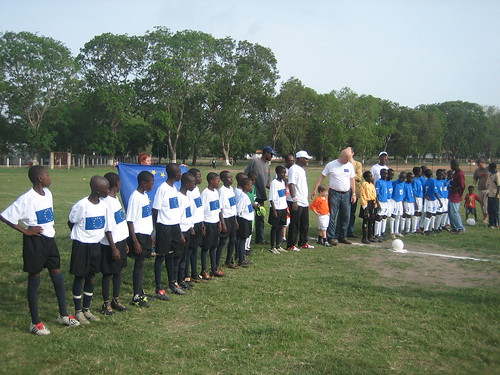
History repeated itself as Accra was witness to some amazing matches between some of the heavyweights of World football last Saturday May 6th.

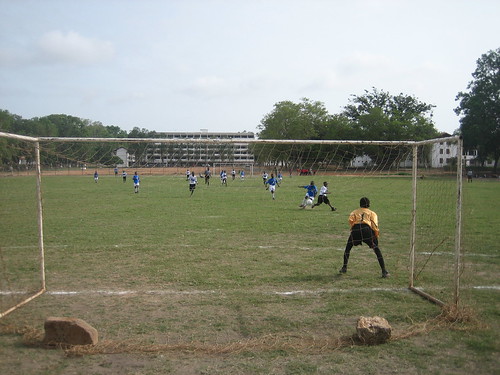
As hordes of fans descended upon University of Legon, kick-off took place at 7 AM, with a clash between the European Union team and Italy. The Italians, in their classic azurri outfits, started defensively against the highly talented EU side. But this was to no avail. One attacking wave after another swept upon the Italian side from the EU youngsters, who were eagerly supported by a large crowd of charming followers. As the EU's 2-0 victory was confirmed, the Italian fans were silent as a grave in the midst of the EUphoria.

However, the expectations caused by the EU's victory were only to be shattered in the second round. Netherlands had dispatched the French with a resounding and entertaining 6-4 victory, and were now to face the noble EU youngsters in what could easily become a modern classic of football. The EU team fought hard to stay in the match, but in the end to no avail against the mighty orange attacking machine. The fans however, displayed fairness and thanked their team for their marvelous performance.

The preliminary round matches saw some more exciting football. In a preview of the upcoming World Cup 2006 clash, the Black Stars from Ghana faced the Czech Republic. In a highly awaited match, both teams displayed fair play and friendliness. In spite of this, the Ghanaians had no quarrels in pounding some Czech fufu for their breakfast. The Czechs were sent home with a resounding 3-0, and should not be expecting any gifts in Germany either.

In spite of their glorious start, the Ghanaians could not keep it going, as they ran into the well-oiled German football machine in the next round. The Germans had defeated Spain in a match where the result was the same as their encounter in the Euro 1988. The Germans defeated the charming home-team 3-0, and were more and more looking like the ones to defeat.

A highly awaited encounter in the preliminary round was England-Denmark. As so often happens in these matches, the Danes were far superior to the Spice Boys, who were dispatched with 3-0. Wayne Rooney's injury was not the only thing causing headaches in Britain this weekend!

The final round of the tournament was as exciting as football can get. First, Germany faced the Danish Dynamite in a repeat of the legendary 1992 European Championship final. In a nail-biting encounter, none of the teams managed to score, so they had to proceed to a nerve-wrecking penalty shootout. The goalie of the German team proved as cool as the legendary Harald Schumacher against Mexico in 1986 World Cup, and put the Germans in the final.

While the Danes had to conform to third place, the wind of history swept across the fields in Legon that hot Saturday afternoon. The final was to be one of the most classic encounters in football history: a repeat of the 1974 World Cup final, of the Euro 1988 semifinal, or the World Cup 1990 last-16 match. None other than the giants from the Netherlands and Germany!

As the fans from each team lined up their support for another clash of Titans, the teams got ready for another nerve-wrecking and close encounter. The orange attacking waves swept over the German side, the Germans kept their cool in the hot afternoon. In what was a repeat of football history, the German team took home the title after an amazing penalty shootout, where only the strongest managed not to faint.

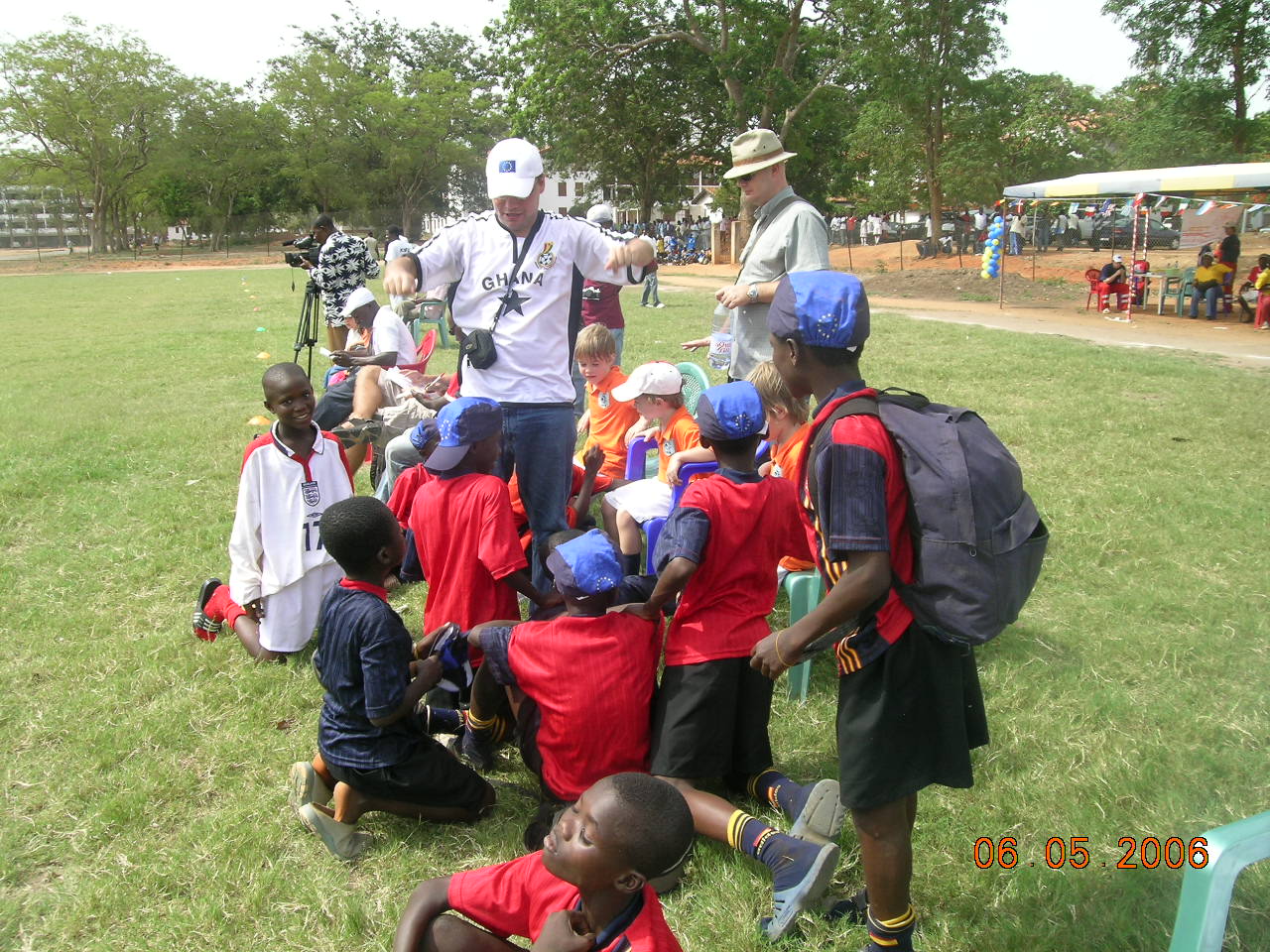
In the end, the true winners of the tournament were all the Ghanaian u-12 teams who could participate in this fun tournament! They were all the true stars of the day, and I was only a lucky football fanatic who happened to be around!

Playing around