Showing posts with label Geoff Hurst. Show all posts
Showing posts with label Geoff Hurst. Show all posts
Monday, April 21, 2014
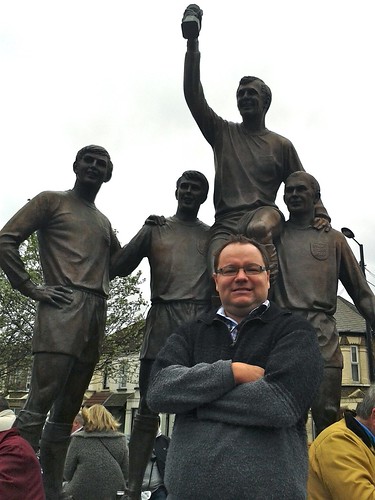
World Cup Sculpture
The following photo is of me in front of the statue of the 1966 World Cup winners, Bobby Moore Geoff Hurst, Martin Peters and Ray Wilson, when I recently went to the West Ham-Liverpool game in London.


Saturday, November 21, 2009
Greatest World Cup matches: England-West Germany (1966)
For the World Cup in England the home nation was full of expectations. Having never won a World Cup before, everyone thought that England should excel at home, and had indeed assembled a very strong team, where the West Ham captain Bobby Moore, led what became the best defense of the World Cup. In midfield the star was Bobby Charlton from Manchester United, an extraordinary offensive midfielder who was awarded the title of best European player of the year of 1966.
In spite of this strong team, England had not had an easy time, and had mainly prevailed because of their strong defense that didn’t let in a single goal until the semifinal.
The English had been in a rather easy first round group which they had won ahead of Uruguay (a poor side that they had only managed to tie 0-0 with), and in the quarterfinal had won a narrow 1-0 victory against Argentina in a match that was marred by a controversial German referee who had left Argentina with ten men after expelling the Argentinean captain Rattin for not liking how he looked at him.
In the semifinal the English had strangely been allowed to change the venue of the match to Wembley, where the best defense of the tournament, England, had faced the best attacking side of the tournament, Portugal. In spite of allowing Eusebio to score the first goal against them, England won their best match in the tournament with two goals by Bobby Charlton, and was ready to play the final in Wembley against the rivals of West Germany.
The Germans had by 1966 again built up a strong disciplined team combining of experienced and young players. They were captained by Uwe Seeler, the Hamburg striker (who was playing his third World Cup), and had a strong and offensive midfield with Helmut Haller from Bologna. These were supplemented by a strong defense where a 21-year old player from Bayern Munich had been noted in the tournament: Franz Beckenbauer totally changed what it meant to be a defender, scoring many goals coming from his “free” position, and was to become one the greatest players of all time.
In the first round the Germans had won their group ahead of Argentina, Spain and Switzerland. In the quarterfinals they had destroyed Uruguay 4-0, and had in the semifinal defeated the USSR 2-1.
There were understandably huge expectations to the final between two European giants, but England were firm favourites in what was to become a legendary drama.
Helmut Haller brought West Germany ahead after twelve minutes after picking up a bad clearing from Ray Wilson. However, only five minutes elapsed before West Ham’s Geoff Hurst levelled the match for England. Geoff Hurst had only entered the tournament in the quarterfinal against Argentina as a substitute for Jimmy Greaves.
He was to become one of the great players of the final.
First half ended 1-1 in what had until then been an equal encounter.
The English entered the second half with the decision to create a result, and had much more possession in the second half, but without being able to force clear chances on the disciplined German defense. However, continued pressure finally bore fruit for the home side in the 78th minute: Allan Ball took a corner kick that reached Geoff Hurst, whose shot bounced off the foot of the Werder Bremen defender Horst-Dieter Höttges, and was picked up by another West Ham player, Martin Peters, who calmly placed the ball around the German goalkeeper Hans Tilkowski.
England was ahead 2-1 and the world cup title was within grasp; but the Germans never give up!
West Germany started to attack, hoping to get an equalizer, and only one minute before the end of the match when the defender Wolfgang Weber tackled his way to the far post after a free kick, and by way of his foot and an English defenders’ knee, pushed the ball into goal and an equalizer for West Germany.
Disappointingly for many English fans, the match had to go into extra time. In spite of both teams being exhausted, England apparently found some energy; notably the hard workingAllan Ball, who halfway through the first half of extra time, caught a ball at the far corner flag, and made a pass backwards to Geoff Hurst in the German area. Hurst stopped the ball and shot quickly and hard towards the goal. The ball hit the post and headed down, out of the goal, where a German defender headed it away as the English players lifted their arms appealing for goal.
It was impossible to see whether the ball had been in, but the referee, after consulting the linesman, awarded the goal to England.
This goal remained very controversial, but it has only been able to seen later with modern technology that the “whole of the ball” had not passed over the goalline, and therefore the goal should not have been allowed.
Nevertheless, this was impossible for the referee to see, and there was no doubt that England had been the better team and deserved to be ahead 3-2.
The Germans were very tired, and unable to respond to an English team that continued attacking. In the very last minute of the extra time Geoff Hurst received the ball in a counterattack and running towards the German goal scored his third goal and England’s fourth, which sealed their victory. Geoff Hurst to this day remains the only player in the history of the World Cup to have scored three goals in a final.
In spite of the controversial goal, nobody could take away that England, the home of football, had deservedly won its first (and to date only) World Cup title.
There have been many myths created around England’s triumph, but there was nothing particularly “gallant” about the English side: it was strong, they deservedly won the world cup on the two last matches, but had certainly had much favouring from FIFA in the form of venues and referees.
Still, football had returned home, at least for four years.
Match Stats:
Goals: 0-1 Haller (12), 1-1 Hurst (18), 2-1 Peters (78), 2-2 Weber (90), 3-2 Hurst (98), 4-2 Hurst (120)
Teams:
England: Banks, Cohen, Wilson, Stiles, J. Charlton, Moore, Ball, Hurst, R. Charlton, Hunt, Peters
West Germany: Tilkowski, Hottges, Weber, Schulz, Schnellinger, Beckenbauer, Haller, Overath, Seeler, Held, Emmerich
In spite of this strong team, England had not had an easy time, and had mainly prevailed because of their strong defense that didn’t let in a single goal until the semifinal.
The English had been in a rather easy first round group which they had won ahead of Uruguay (a poor side that they had only managed to tie 0-0 with), and in the quarterfinal had won a narrow 1-0 victory against Argentina in a match that was marred by a controversial German referee who had left Argentina with ten men after expelling the Argentinean captain Rattin for not liking how he looked at him.
In the semifinal the English had strangely been allowed to change the venue of the match to Wembley, where the best defense of the tournament, England, had faced the best attacking side of the tournament, Portugal. In spite of allowing Eusebio to score the first goal against them, England won their best match in the tournament with two goals by Bobby Charlton, and was ready to play the final in Wembley against the rivals of West Germany.
The Germans had by 1966 again built up a strong disciplined team combining of experienced and young players. They were captained by Uwe Seeler, the Hamburg striker (who was playing his third World Cup), and had a strong and offensive midfield with Helmut Haller from Bologna. These were supplemented by a strong defense where a 21-year old player from Bayern Munich had been noted in the tournament: Franz Beckenbauer totally changed what it meant to be a defender, scoring many goals coming from his “free” position, and was to become one the greatest players of all time.
In the first round the Germans had won their group ahead of Argentina, Spain and Switzerland. In the quarterfinals they had destroyed Uruguay 4-0, and had in the semifinal defeated the USSR 2-1.
There were understandably huge expectations to the final between two European giants, but England were firm favourites in what was to become a legendary drama.
Helmut Haller brought West Germany ahead after twelve minutes after picking up a bad clearing from Ray Wilson. However, only five minutes elapsed before West Ham’s Geoff Hurst levelled the match for England. Geoff Hurst had only entered the tournament in the quarterfinal against Argentina as a substitute for Jimmy Greaves.
He was to become one of the great players of the final.
First half ended 1-1 in what had until then been an equal encounter.
The English entered the second half with the decision to create a result, and had much more possession in the second half, but without being able to force clear chances on the disciplined German defense. However, continued pressure finally bore fruit for the home side in the 78th minute: Allan Ball took a corner kick that reached Geoff Hurst, whose shot bounced off the foot of the Werder Bremen defender Horst-Dieter Höttges, and was picked up by another West Ham player, Martin Peters, who calmly placed the ball around the German goalkeeper Hans Tilkowski.
England was ahead 2-1 and the world cup title was within grasp; but the Germans never give up!
West Germany started to attack, hoping to get an equalizer, and only one minute before the end of the match when the defender Wolfgang Weber tackled his way to the far post after a free kick, and by way of his foot and an English defenders’ knee, pushed the ball into goal and an equalizer for West Germany.
Disappointingly for many English fans, the match had to go into extra time. In spite of both teams being exhausted, England apparently found some energy; notably the hard workingAllan Ball, who halfway through the first half of extra time, caught a ball at the far corner flag, and made a pass backwards to Geoff Hurst in the German area. Hurst stopped the ball and shot quickly and hard towards the goal. The ball hit the post and headed down, out of the goal, where a German defender headed it away as the English players lifted their arms appealing for goal.
It was impossible to see whether the ball had been in, but the referee, after consulting the linesman, awarded the goal to England.
This goal remained very controversial, but it has only been able to seen later with modern technology that the “whole of the ball” had not passed over the goalline, and therefore the goal should not have been allowed.
Nevertheless, this was impossible for the referee to see, and there was no doubt that England had been the better team and deserved to be ahead 3-2.
The Germans were very tired, and unable to respond to an English team that continued attacking. In the very last minute of the extra time Geoff Hurst received the ball in a counterattack and running towards the German goal scored his third goal and England’s fourth, which sealed their victory. Geoff Hurst to this day remains the only player in the history of the World Cup to have scored three goals in a final.
In spite of the controversial goal, nobody could take away that England, the home of football, had deservedly won its first (and to date only) World Cup title.
There have been many myths created around England’s triumph, but there was nothing particularly “gallant” about the English side: it was strong, they deservedly won the world cup on the two last matches, but had certainly had much favouring from FIFA in the form of venues and referees.
Still, football had returned home, at least for four years.
Match Stats:
- 30th July, 1966 Wembley Stadium, London
- Attendance: 96,994
- Referee: Gottfried Dienst (Switzerland)
Goals: 0-1 Haller (12), 1-1 Hurst (18), 2-1 Peters (78), 2-2 Weber (90), 3-2 Hurst (98), 4-2 Hurst (120)
Teams:
England: Banks, Cohen, Wilson, Stiles, J. Charlton, Moore, Ball, Hurst, R. Charlton, Hunt, Peters
West Germany: Tilkowski, Hottges, Weber, Schulz, Schnellinger, Beckenbauer, Haller, Overath, Seeler, Held, Emmerich
Saturday, November 14, 2009
Greatest World Cup matches: England-Argentina (1966)
England and Argentina have one of the most intense rivalries in world football, surely the only classical cross-continental footballing rivalry. Being two of the most passionate footballing nations in the world, and much more closely associated than many know (indeed, the English brought football to Argentina in the 19th century!), the matches they have played have been intense, passionate and controversial.
The rivalry started with this quarterfinal of the 1966 World Cup. Argentina had progressed with victories against Spain and Switzerland, and a 0-0 against West Germany, while England had defeated Mexico and France, while tying 0-0 with Uruguay.
While West Germany faced Uruguay, England faced Argentina in the quarter-final, and the English referee in the former match took the attention of the match as much as the German referee in the latter match, prompting theories of an Anglo-German conspiracy against the South Americans.
The referee of this match, Rudolf Kreitlein from West Germany, had a call that is still considered one of the strangest in World Cup football, and has led to many in Argentina calling this match the “Robbery of the century”: Argentina’s captain, the Boca Juniors legend Antonio “La Rata” Rattín, was suddenly in the 25th minute expelled from the match, being the first player ever to be expelled in a World Cup (red cards had not been introduced yet). In a long discussion with the referee, Rattin refused to leave, and called for a translator, but it was refused. Mr. Kreitlein argued that he had taken the decision, since he “didn’t like how he [Rattín] was looking at me.”
Of course, the entire match was overshadowed by this incident, but when watching the match again one cannot say that the match was specially violent (nothing in comparison with what Portugal had subjected Brazil to in the first round), and Alf Ramsey’s comment after the match seemed out of place: "It seemed a pity so much Argentinian talent is wasted. Our best football will come against the right type of opposition - a team who come to play football, and not act as animals."
This type of comment only added to the bad faith between the two teams, which Alf Ramsey was only too eager to promote: When looking at the TV pictures of the end of the match, one can see players peacefully congratulating each other and ready to exchange shirts, when an over-excited Ramsey runs onto the pitch to prevent the players from exchanging shirts.
In spite of only ten men for the most of the match, Argentina held on against a superior side, until the West Ham striker Geoff Hurst scored the winning goal on a beautiful header in the 78th minute on a great pass by the young Martin Peters.
Hurst had not played any of the first round matches, but had started against Argentina when Jimmy Greaves was injured.
England was the better team of the two in spite of Argentina playing a fine match. Still, the fact that they were better is certainly overshadowed by the bad refereeing, as much as it would be 20 years later in another World Cup quarterfinal...
To this date, there is nothing but hate between the English and Argentinean fans, which is a pity considering that they are both great teams that have played intense matches with lousy referees.
Match Stats:
Goals: 1-0 Hurst (78)
Teams:
England: Banks; Cohen, Wilson, Stiles, J. Charlton, Moore, Ball, B. Charlton, Peters, Hunt, Hurst
Argentina: Roma; Irusta, Perfumo, Marzolini, Ferreiro, Rattin (RC, 25), Solari, Gonzalez, Ortime, Onega, Mas
The rivalry started with this quarterfinal of the 1966 World Cup. Argentina had progressed with victories against Spain and Switzerland, and a 0-0 against West Germany, while England had defeated Mexico and France, while tying 0-0 with Uruguay.
While West Germany faced Uruguay, England faced Argentina in the quarter-final, and the English referee in the former match took the attention of the match as much as the German referee in the latter match, prompting theories of an Anglo-German conspiracy against the South Americans.
The referee of this match, Rudolf Kreitlein from West Germany, had a call that is still considered one of the strangest in World Cup football, and has led to many in Argentina calling this match the “Robbery of the century”: Argentina’s captain, the Boca Juniors legend Antonio “La Rata” Rattín, was suddenly in the 25th minute expelled from the match, being the first player ever to be expelled in a World Cup (red cards had not been introduced yet). In a long discussion with the referee, Rattin refused to leave, and called for a translator, but it was refused. Mr. Kreitlein argued that he had taken the decision, since he “didn’t like how he [Rattín] was looking at me.”
Of course, the entire match was overshadowed by this incident, but when watching the match again one cannot say that the match was specially violent (nothing in comparison with what Portugal had subjected Brazil to in the first round), and Alf Ramsey’s comment after the match seemed out of place: "It seemed a pity so much Argentinian talent is wasted. Our best football will come against the right type of opposition - a team who come to play football, and not act as animals."
This type of comment only added to the bad faith between the two teams, which Alf Ramsey was only too eager to promote: When looking at the TV pictures of the end of the match, one can see players peacefully congratulating each other and ready to exchange shirts, when an over-excited Ramsey runs onto the pitch to prevent the players from exchanging shirts.
In spite of only ten men for the most of the match, Argentina held on against a superior side, until the West Ham striker Geoff Hurst scored the winning goal on a beautiful header in the 78th minute on a great pass by the young Martin Peters.
Hurst had not played any of the first round matches, but had started against Argentina when Jimmy Greaves was injured.
England was the better team of the two in spite of Argentina playing a fine match. Still, the fact that they were better is certainly overshadowed by the bad refereeing, as much as it would be 20 years later in another World Cup quarterfinal...
To this date, there is nothing but hate between the English and Argentinean fans, which is a pity considering that they are both great teams that have played intense matches with lousy referees.
Match Stats:
- 23rd July 1966, Wembley Stadium, London
- Attendance 90,000
- Referee: Rudolf Kreitlein (West Germany)
Goals: 1-0 Hurst (78)
Teams:
England: Banks; Cohen, Wilson, Stiles, J. Charlton, Moore, Ball, B. Charlton, Peters, Hunt, Hurst
Argentina: Roma; Irusta, Perfumo, Marzolini, Ferreiro, Rattin (RC, 25), Solari, Gonzalez, Ortime, Onega, Mas
Subscribe to:
Posts (Atom)