As we are approaching the another “Clasico” next weekend, it is interesting that I read an excellent book on the rivalry between the two giants of European football, Sid Lowe's “Fear and Loathing in La Liga”.
Football is politics. And in certain cases it can be beautiful both despite politics and because of politics.
The classic clash between Barcelona and Real Madrid is one of these matches; every time they play is a guarantee of fantastic football and politics. Sid Lowe's book describes the history of this rivalry, both in political and in football terms, but mostly, how they both have mingled to create a rivalry that today is followed by the entire world.
The rivalry is not only about historical facts, but also about myths: Barcelona sees itself as the righteous rebels against Franco's regime, while Real Madrid sees itself as a club of gentlemen and good football.
But there are many more nuances to this history, as Sid Lowe so amply shows. For instance, during the civil war a Real Madrid president was in fact part of the anti-Franco Republican government, while Barcelona, after having competed during the civil war (contrary to Real Madrid, as the city was under siege), became the dominant team in Spain immediately after the war. Real Madrid was from the 1950s largely run by a pro-government president, Santiago Bernabeu, who led the way in making them the best team in the world in the 1960s, ahead of a Barcelona side that constantly saw a conspiracy behind Real Madrid's success. This is mostly showed by the myth that Alfredo Di Stefano was “stolen” from them, while it rather appears that they were less smart than Real Madrid in a complex negotiation involving clubs in Argentina and Colombia.
The transition up to and after Franco's death is very interesting, when Johan Cruyff went to Barcelona as a player, and a new period of rivalry started. In football terms during the 1980s and 1990s the rivalry became the best in the world, with the best players in the world having played for either club. The list is simply amazing when one sees the players that have gone through either (or both in some cases!): Paul Breitner, Gary Lineker, Hugo Sanchez, Diego Maradona, Ronaldo, Hristo Stoichkov, Emilio Butragueno, Michael Laudrup, Zinedine Zidane, Ronald Koeman, Raul, Romario, Luis Figo.... etc... The book has fantastic interviews with many of these players!
In the 1990s Johan Cruyff, now as coach, set the foundation for what made the great Barcelona of the 2000s. In an attempt to be as good as FC Barcelona, Real Madrid's president, Florentino Perez, was instrumental in wanting to create a global brand spending millions on the best players in the world. In all, the 2000s became a period of rivalry defined by the best football in the world, money, and not least politics, as FC Barcelona continues to be an entry point of a growing Catalan nationalism demanding independence from Spain (the book starts with a highly politicized game of 2012 when thousands of fans in Barcelona shouted for independence during the match).
In this regard, the clashes are as political as ever, but at the same time the match has become a global affair: the best footballers in the world facing one another in a match that is never insignificant, but a final every time. The teams are completely dominating in Spain, and their high class also makes them among the best teams in Europe (since 2000 Real Madrid and FC Barcelona have won three and four Champions League respectively) and surely in the world.
Sid Lowe is an English journalist, and that gives the book strength, as he does not take sides in what is a rivalry full of bitterness and myths, something that is surely difficult. Many fanatical fans of either Real Madrid or Barcelona are probably not going to like the book as he tries to demystify some of their stories.
In the end, one realizes that these two teams need one another. They would not be able to define themselves without that rivalry, which has surely pushed them to always be better, until now them being both the best. It is a perfect symbiosis of opposites that has given us some of the best football we can wish for.
Any football fan should love this rivalry, and there is no better book to understand it.
Thursday, March 31, 2016


Monday, March 28, 2016
FC Barcelona fishermen
Football transcends borders, and in the small fishing village of Marshall, in Liberia, I came across a number of fishing boats with football names. Andres Iniesta and Neymar were two of the nicest boats, decorated with FC Barcelona and Brazil colours respectively, paying homage to these two great players.
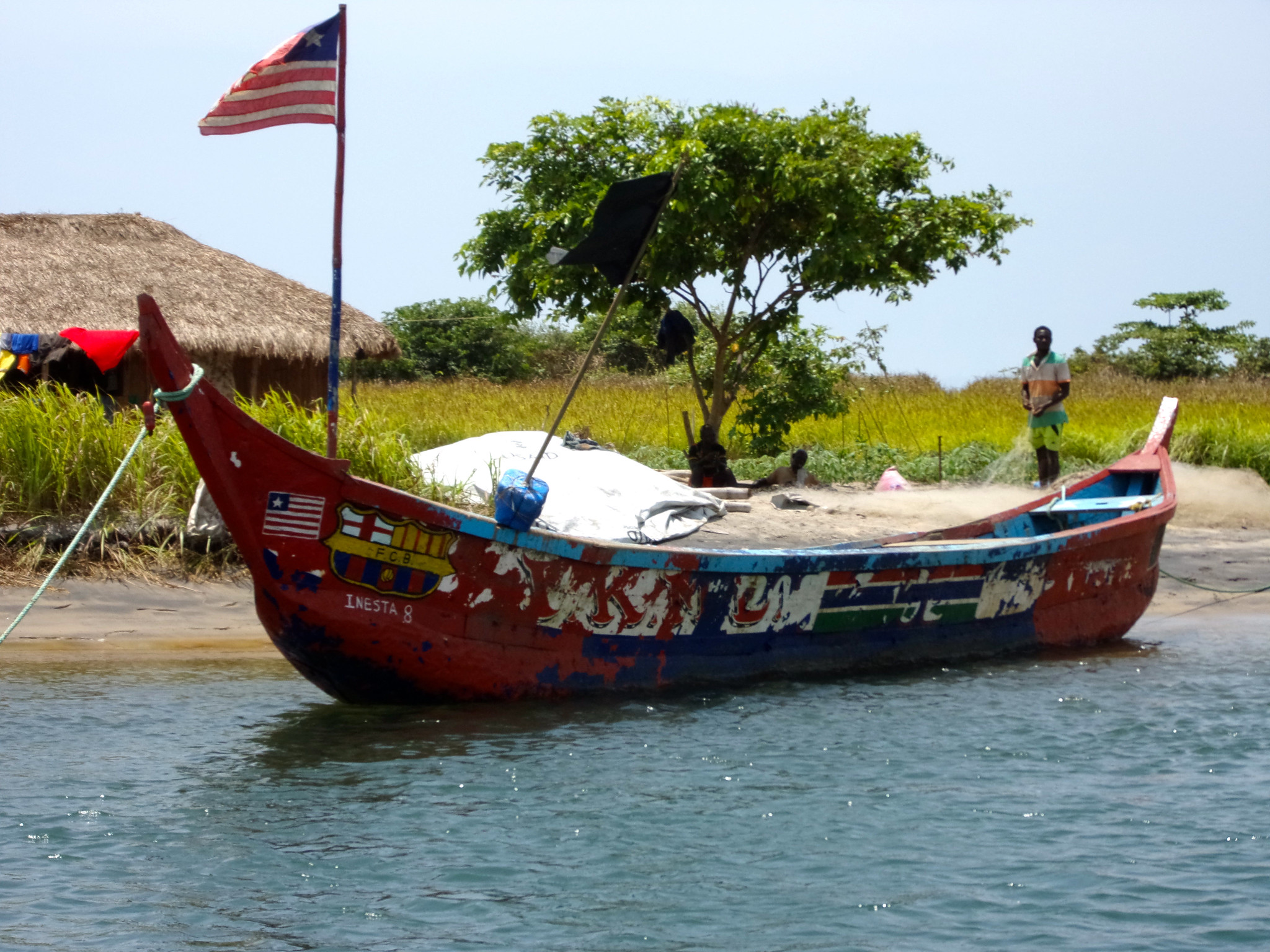
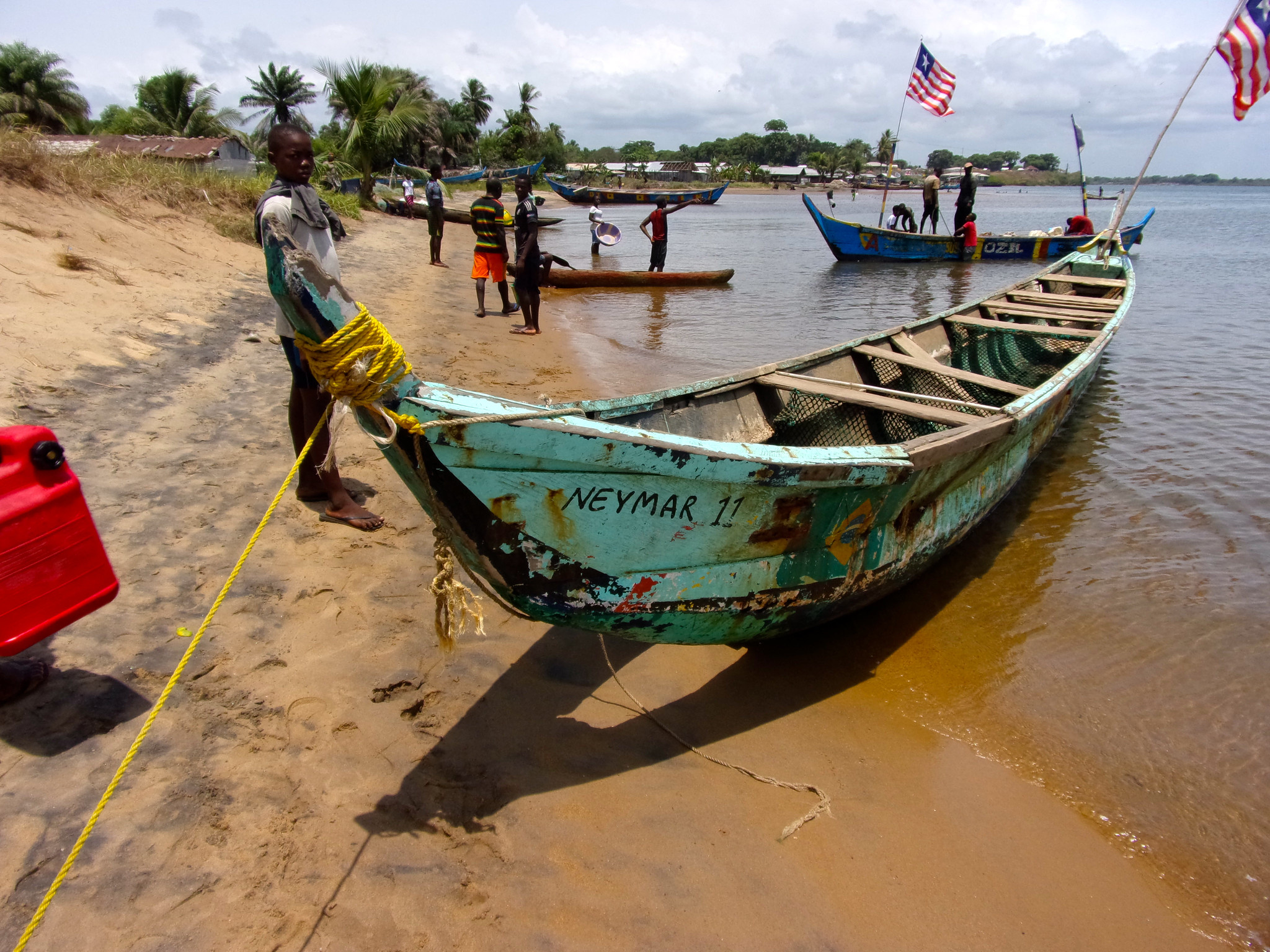 One boat also had the Chelsea logo on it. When I called him "Chelsea-man", all the other fishermen started laughing.
Football transcends borders; and so does making fun of Chelsea.
Football transcends borders; and so does making fun of Chelsea.
Sunday, March 27, 2016
The Greatest Euro Matches: Scotland-CIS (1992)
The USSR had made it to its fourth European championship final in 1988 when they lost to the Netherlands. It was thus the team that had played most Euro finals at the time, and was central to the entire history of the tournament. Four years later, the USSR had ceased to exist as historical events had changed the landscape in Europe. While the USSR had qualified in a group ahead of Italy, by the time the tournament started, the country had dissolved into 15 new countries. The solution would be either to let the second in the group in, or let USSR participate with the team that had qualified. UEFA opted for the latter option, and thus was born the “Community of Independent States” team, or CIS, a mixture of players from former USSR countries (dominated by Russia, but also players who came to play for Ukraine, Georgia and Belorussia). It was a side with excellent and experienced players, who had played in World Cups and European Championships, including the final four years before. After the opening of the USSR many of the players had gone to play in European clubs, so it was also a side with international experience. The captain of the team was Glasgow Ranger's Ukranian, Alexei Mikhailichenko. In defense his teammate in Glasgow, the veteran Oleh Kuznetsov, stood the two Spartak Moscow players Andrei Chernyshov and Kakhaber Tkhadadze. Sergei Aleinikov from Lecce and Igor Dobrovolski from Servette Geneve stood behind a powerful striking force with the young Manchester United star Andrei Kanchelskis, Benfica's Sergei Yuran, and the young Sergei Kiriakov from Dynamo Moscow.
The CIS had started the tournament with a 1-1 with Germany and 0-0 with the Netherlands, and thus stood as favourites to progress before their last match against unfancied Scotland, who had started by losing both their first matches to the Netherlands and Germany, and were thus effectively out of the tournament. Scotland had qualified ahead of Switzerland, Romania and Bulgaria. The team captain was Richard Gough from Glasgow Rangers, and the side included such players as Brian McClair from Manchester United, Gary MacAllister from Leeds, as well as the striker Ally McCoist from Glasgow Rangers.
But it were the Scottish, with only pride to play for, that were soon in the lead, when Paul MacStay, from Glasgow Celtic took a shot from outside. The flat but hard shot hit the post and bounced of goalkeeper Dmitri Kharin's head to make it a lucky 1-0 for Scotland. Barely ten minutes later Scotland got ahead 2-0 when Brian McClair shot from outside. His shot was deflected by Tkhadadze and cheated Kharin. Again somewhat lucky, but still 2-0.
The CIS were shaken by the motivated Scots, but started dominating the match as the Scots pulled back. Sergei Yuran came close and Igor Dorbovolski and Igor Korneev were incredibly unlucky not to score in a double chance. Instead, with six minutes to go Scotland was awarded a penalty in a situation where Paul Nevin was clumsily brought down in the penalty area amid already defeated CIS defenders. Gary MacAllister did not miss, and Scotland went home with their heads held high, and took the CIS with them.
With this, the CIS, or former USSR, ceased to exist as a footballing nation, as the players from this side went on to play for Russia, Belorussia, Ukraine and Georgia.
Football is a reflection of society and history. On the football pitch, this match was an expression of the demise of the formerly great team of the USSR.
Norrkobing, 18th June 1992 Idrottsparken
Attendance: 14600
Referee: Kurt Rothlisberger (Switzerland)
Scotland-CIS 3-0
Scotland: Andy Goram; Richard Gough (c), Tom Boyd, Dave McPherson, Stewart McKimmie, Paul McStay, Gary McAllister, Stuart McCall, Brian McClair (Jim McInally, 65), Ally McCoist, Kevin Gallacher (Pat Nevin, 79). Coach: Andy Roxburgh
CIS: Dmitri Kharin; Andrey Chernyshov, Kakhaber Tskhadadze, Oleh Kuznetsov, Alexei Mikhailichenko (c), Sergei Aleinikov (Dmitri Kuznetsov, 46), Viktor Onopko, Andrei Kanchelskis, Igor Dobrovolski, Sergei Yuran, Sergei Kiriakov (Igor Korneev, 46). Coach: Anatoliy Byshovets
Goals:
1-0 Paul McStay (7)
2-0 Brian McClair (16)
3-0 Gary McAllister (pen) (84)
Thursday, March 24, 2016
RIP Johan Cruyff
Football is art, and great football is
great art. And Johan Cruyff was indeed one of the greatest football
artists the world has ever seen. His greatness went beyond his
outstanding technical skills and physical qualities, but what made
him one of the men that has changed football, was that he perhaps
more than anybody else, was the first great footballer who “thought”
football; who combined his skills and his brains to develop a whole
new style of football.
As a player he won three European Cups
with Ajax Amsterdam, as well as la Liga and Copa del Rey with FC
Barcelona. He also, more than any of the other immensely talented
players of a great Dutch generation, symbolized the Total Football
that took the Netherlands to two World Cup finals, and made them
darlings of the world.
As a manager he took all his skills to
create a style of football that led FC Barcelona to four league
titles in a row in the early 1990s, and FC Barcelona's first ever
European Cup triumph in 1992. More than anyone else he created the
foundation for the FC Barcelona style of today, meaning that not only
Barcelona should be thankful, but also the Spanish national team, who
would never have won the 2010 World Cup without that style.
The Netherlands, Spain, and the entire
football world should be sad with his parting, but at the same time
thankful for everything he gave to the entire football world.
An artist and a genius is joining
Heaven's top League today.
Tuesday, March 22, 2016
The Greatest Euro Matches: Netherlands-USSR (1988)
In the 1980s the USSR had one of the strongest teams in the world. The coach as the Ukranian Valery Lobanovsky, who had led Dynamo Kiev to become the dominant team in the USSR, as well as winning two European titles. In 1986 he took over as national team coach. His squad for 1988 included eleven players from Dynamo Kiev. Most notably were Igor Belanov, European player of the year in 1986, the dangerous striker with a hammering kick Oleg Protasov, the strong defenders Anatoliy Demyanenko and Oleg Kutznezov, as well as the elegant midfielders Vasiliy Rats and Aleksader Zavarov. The captain of the team was the legendary goalkeeper Rinat Dasaeev from Spartak Moscow, widely considered to be the best in the world. It was an awesome and physically strong side that functioned like a smooth collective.
The Soviets had qualified in a difficult group ahead of East Germany and France. In the opening match of the Euro 1988 they faced the Netherlands. It was a strange match. The USSR dominated the midfield but the Dutch had many huge chances that were spectacularly saved by an impenetrable Dasaeev. In the end the USSR won on a goal by Vassiliy Rats. A tie with Ireland and a victory over England, gave them first spot in the group.
In the semi-final the USSR were stronger than Italy in every respect, and won 2-0. In the final they would face the team they beat in their opening match, the Netherlands.
The Dutch had grown during the tournament, and in spite of their opening defeat, they were favourites in the final.The had defeated England 3-1 and Ireland 1-0. In the semifinal they had defeated the home side of West Germany in a very dramatic match, and had all reason to be confident before the final. The stars of the team were AC Milan's star striker Marco Van Basten (who had scored the winner against West Germany), and the captain Ruud Gullit, also from AC Milan. They were complemented by a string of outstanding players: Zaragoza's Frank Riijkaard, PSV's Ronald Koeman, Barry Van Aerle and Gerald Vanenburg, as well as Mechelen's Erwin Koeman and Ajax's Jan Wouters.
After defeating West Germany the Dutch had avenged the ghost of the 1974 final. Now, there was a second (albeit smaller) ghost to avenge, as they would be playing at Olympiastadium in Munich, the same place where they had lost that 1974 final.
Rinus Michels only made one change compared to the team that had faced the USSR in the first round: Erwin Koeman came on instead of John Van't Schip. The USSR was seriously weakened though, as two of their best defenders, Oleg Kuznetsov and Volodimir Bessonov, both from Dynamo Kiev, were both out on suspension. Instead, Litovchenko opted for a more massive and offensive midfield, but his change of Sergei Aleinikov, a midfielder, in place of Kuznetzov, seemed misplaced.
Despite this, the first 20 minutes of the match the Soviets seemed more comfortable on the pitch, and Litovchenko had a good chance to put the Soviets ahead, but was prevented by Van Breukelen. After half an hour the Dutch seemed more settled and Ruud Gullit had an excellent free kick that was well saved by Dassaev. In the following corner kick a return ball landed with Erwin Koeman, who crossed to the far post. Van Basten had been told to stay at the far post, where Aleinikov did not pull forward for the off-side trap. Van Basten headed the ball into Gullit, in front of goal, who headed hard and brought the Dutch ahead 1-0.
While a disappointment for the Soviets, they continued going forward, and Igor Belanov had a huge chance in front of goal, but shot over the goalposts. The Soviets pushed forward in the second half. But ten minutes into the second half Marco Van Basten scored one of the most memorable and fantastic goals in European championship history. Arnold Muhren crossed from the left into the Soviet area. It was not a particularly good cross, sailing towards the back line. However, Marco Van Basten rushed towards the ball, and made the impossible shot: he first-timed the ball from a sharp angle, and the ball went spectacularly in behind a stunned Dassaev.
Igor Belanov had a shot on the post not long after, but it did not seem they would be able to score. When Van Breukelen saved a penalty by Belanov, it seemed that on this day the USSR had it all against them.
The Netherlands won their first and highly deserved title with a team of fantastic players. The USSR had a great side but had been beaten by a better side. This was the last match the USSR, former champions, played in a European Championship: four years later the world would be changed, and the USSR would no longer exist.
Munich, 25th June 1988, Olympiastadium
Attendance: 72,308
Referee: Michel Vautrot, France
Netherlands-USSR 2-0
Netherlands: Hans van Breukelen; Berry van Aerle, Frank Rijkaard, Ronald Koeman, Adri van Tiggelen, Gerald Vanenburg, Jan Wouters, Arnold Mühren, Erwin Koeman, Marco van Basten, Ruud Gullit (c). Coach : Rinus Michels
USSR: Renat Dassaev (c); Anatoliy Demyanenko, Sergei Aleinikov, Vagiz Khidiyatullin, Vasiliy Rats, Hennadiy Litovchenko, Aleksander Zavarov, Alexei Mikhailichenko
Goals:
1-0 Ruud Gullit (32)
2-0 Marco Van Basten (54)
Subscribe to:
Posts (Atom)